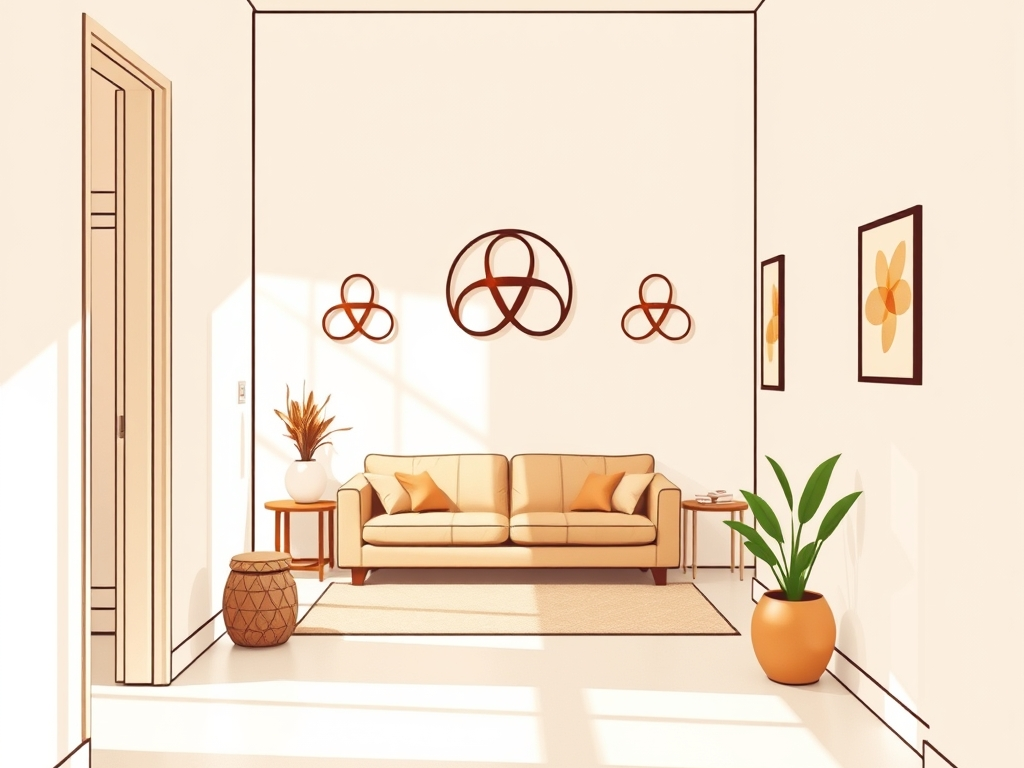
When a room feels slightly wrong and nobody can say why, the cause is often behind them. The wall behind the sofa is the back of the main seating area, and in feng shui it represents support: the quiet structure that lets people settle, talk, and rest without the feeling of exposure. A sofa floating in the middle of a room, or backed by a window or a busy passage, makes the people on it feel unheld, even when they cannot name the feeling. If the room itself is new to your study, begin with The Living Room and Social Energy.
This article explains why the wall behind the sofa matters, what makes a seating area feel supported, and how to fix the most common problems without redecorating.
What Support Means in a Seating Area
In feng shui, the principle behind the sofa is the same as the principle behind a desk or a bed: solid support behind the person. The sofa is where people spend hours talking, reading, and resting, and the wall behind it gives the back a boundary. Psychologically, a supported back lowers vigilance; physically, it keeps the seating area from feeling like a corridor.
You can test the principle in any waiting room or café: the seats against a wall fill first, and the floating chairs in the middle fill last. People seek support without thinking about it. For how the bagua map organises these qualities in a room, read How the Bagua Map Applies to Your Home.
The Main Problems Behind a Sofa
Three problems appear most often. The first is the floating sofa, with open space behind it, which makes the seating area feel exposed and the room feel divided. The second is the window behind the sofa, which trades support for light and leaves people with a sense of openness at their backs. The third is the passage behind the sofa, where household traffic moves constantly behind the heads of the people sitting down.
Each problem has the same cure in different form: create a boundary between the sofa and whatever is behind it. For how the shape of a room affects its feel, read The Shape of a Room and the Feel of a Space.
Fixes for the Floating Sofa
If the sofa floats, the simplest fix is a console table behind it. The table gives the sofa a visible back, holds a lamp or books, and closes the gap without blocking the room. If the space is large, a low bookshelf or a long bench can do the same work while adding storage.
Choose the table's height so it rises just below the sofa's back, and keep the surface simple so it reads as support rather than clutter. For how furniture lines shape the flow of a room, read Furniture Lines and the Flow of a Room.
Fixes for Windows and Passages
For a window behind the sofa, the practical response depends on light: if the window is not the room's main light source, close it with curtains or place the sofa against a solid section of wall. If the sofa must stay at the window, add a curtain that can close at night and a low table to create a sense of boundary.
For a passage behind the sofa, redirect the traffic if possible, or place a tall plant or screen behind the seating line to slow the movement. The goal is not to block the room but to give the seated person a back that feels settled. For how movement moves through a home, read The Hallway and How Energy Moves.
A Five-Point Support Check
Run this check on your main seating area, and note which items ask for a change.
- Sit in each seat and notice whether your back feels held or exposed.
- Check whether the sofa has a visible boundary behind it.
- Look for traffic paths that pass directly behind the seating.
- Notice what the eye meets from each seat, including doors and windows.
- Choose one change, such as a console, a plant, or a curtain, that adds the most support.
The check turns a vague unease into a concrete list. For how balance relates to the five elements in a room, read The Five Elements in Feng Shui Placement.
Common Mistakes With the Sofa Wall
The first mistake is prioritising the view over support and placing the sofa for the window's sake, then wondering why the room never feels settled. The second is treating the wall as purely visual and ignoring what sits behind the sofa's back. The third is overcorrecting: filling the space behind the sofa with tall pieces that block light and make the room feel like a maze.
A related mistake is assuming the rule means every sofa must touch a wall. In a large open room, a sofa with a well-designed back, such as a console or a low shelf, is perfectly supported without touching anything. For how common feng shui ideas are often misunderstood, read Common Feng Shui Myths.
Support as a Whole-Room Idea
Once you see the wall behind the sofa, you will see the same principle everywhere: the bed needs a solid headboard wall, the desk needs a supported position, and the dining chairs need a wall or a settled corner rather than open traffic behind them. Support is one of the quietest and most reliable ideas in feng shui, because it matches what bodies actually need.
Apply it one seat at a time, and the room will slowly feel less exposed and more lived in. For how the centre of the home carries the whole house, read The Center of the Home and Its Meaning.
Two Living Rooms Compared
The first room has a beautiful sofa placed in the centre, facing the television, with open space and a busy walkway behind it. Every time someone walks past, the seated person's attention flickers; every conversation carries a faint sense of exposure. The room photographs well, but nobody stays long, and the family gathers in the kitchen instead.
The second room is the same size with the sofa moved to the long wall, a low console behind it holding a lamp and a stack of books, and a rug defining the seating zone. The traffic now passes in front of the seating rather than behind it, and the backs of the people sitting are held. The room has less drama and far more use; people linger, talk, and read. The change was not decoration. It was the return of support, which is what a seating area needs before it can do its job.
FAQ
Does my sofa have to be against a wall?
No. It needs a visible boundary behind it, which a console table, low shelf, or screen can provide just as well as a wall.
Is a window behind the sofa always bad?
Not always. If the window is not the main light source and can be curtained at night, the seating can work; the issue is exposure, not the window itself.
What if the room is too small for a console table?
Use a floor plant, a low bench, or even a change in flooring, such as a rug that defines the seating zone, to create the sense of a boundary behind the sofa.
How quickly will the change be noticeable?
Most people notice the seating area feeling calmer within a few days, because the body reads the added support immediately even when the mind does not.