Of all the small surfaces in a home, the bedside table may be the one that speaks loudest at night. It is the last thing you see before sleep and the first thing you see when you wake, and it holds whatever your mind was touching as it crossed into rest. In feng shui terms, the bedside table is part of the bedroom's supportive environment, and its contents either settle the room or keep it running. Most people never think about it, which is exactly why it is worth a look. If you are new to the subject, begin with Bedroom Feng Shui Basics.
This article explains how the bedside table affects sleep, what belongs beside the bed, and how a five-minute clearing can change the feel of the night.
Why the Bedside Table Matters
The bedside table is the boundary object between waking and sleep. During the day it is just furniture, but at night it becomes the landing place for everything the mind carried through the evening: the phone with its notifications, the book half-read, the glass of water, the list of tomorrow's worries. Whatever sits there is what the eyes rest on as consciousness begins to settle.
Feng shui reads this as a matter of supported rest. A clear, calm surface beside the bed supports the transition into sleep; a crowded, stimulating one keeps the mind in its daytime gear. For how the bedroom as a whole supports rest, read The Bedroom and Restful Energy.
What Belongs Beside the Bed
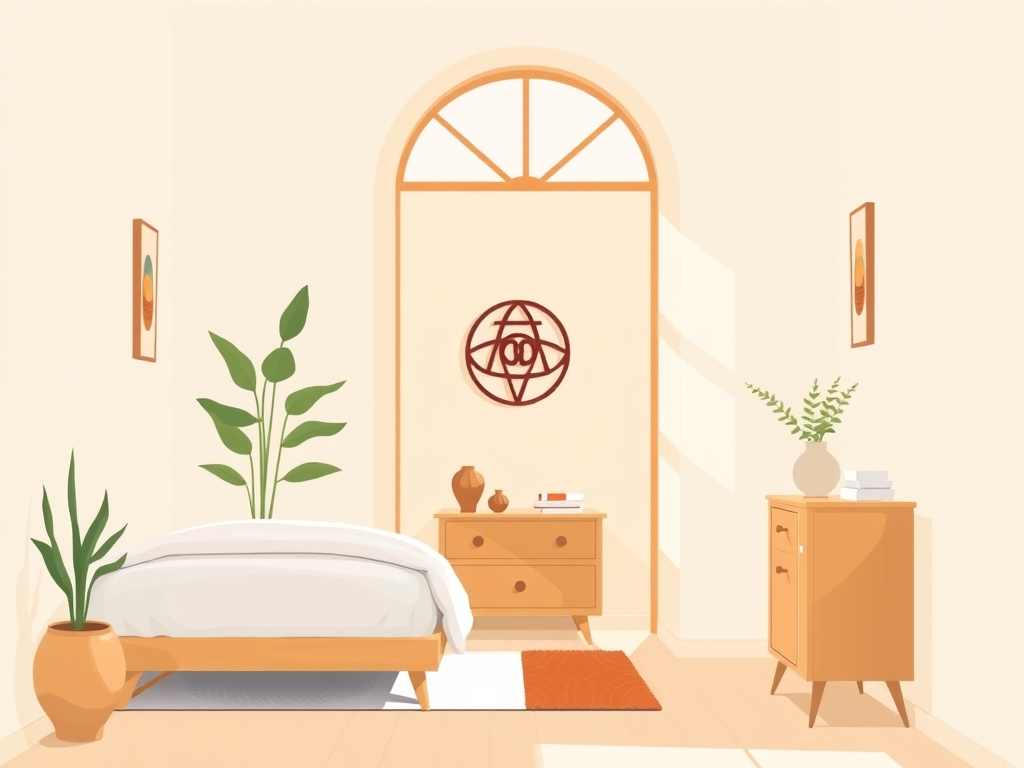
A supportive bedside table is small and intentional. A few things genuinely belong there: water for the night, a book or journal chosen for settling, a lamp with soft light, and perhaps one object that carries a calm association, such as a stone, a photo, or a small plant. Everything else is a candidate for relocation.
The test is simple: ask whether each object helps you arrive or keeps you running. Work documents, screens, and bright clutter fail the test; a glass of water and a quiet book pass it. For how objects affect the feel of a room, read What Makes a Space Feel Balanced.
The Phone Question
The hardest question for most people is the phone. It charges beside the bed, wakes them with alarms, and waits at the edge of sleep with all of its pull. Feng shui does not forbid the phone; it asks where the boundary belongs. If the phone must stay, place it so it is not the last thing seen, cover it, or set it face down with notifications silenced.
Even better, give the phone a home outside arm's reach and use a plain alarm. The physical distance does more than any app setting, because it turns the decision about checking into an actual action. For how light and devices shape rest, read Feng Shui for Lighting and Airflow.
A Five-Minute Clearing Practice
The bedside table can be reset in five minutes, and the practice works best when repeated weekly.
- Remove everything from the surface and wipe it clean.
- Sort the objects into three piles: keep, relocate, and clear away.
- Return only the objects that support sleep: water, a book, a lamp, one calm object.
- Relocate the phone and any work items to their daytime homes.
- Dust the lamp and check that the light is soft and adjustable.
- Step back and notice how the surface feels before you leave the room.
The practice takes minutes and returns a small feeling of order every night. For a similar practice in another part of the home, see Clutter in a Drawer: A Small Feng Shui Practice.
Balance and Symmetry at the Bed
Traditional practice often pairs bedside tables, one on each side of the bed, because equal supports create a balanced base for rest. The symmetry matters less than the support: both sides should carry a similar calm, so that the bed feels held rather than uneven. In a small room where two tables are impossible, a single table plus a low shelf or stool on the other side can carry the same intention.
What matters most is that both sleepers, or both sides of your own sleep, have a place for the night's few objects. For how balance relates to the elements of a room, read The Five Elements in Feng Shui Placement.
Common Mistakes With the Bedside Table
The first mistake is treating the table as storage and letting paperwork, chargers, and cups collect through the week. The second is focusing on aesthetics and forgetting function: a beautiful table that cannot hold water and a lamp is not doing its job. The third is expecting the table to fix sleep by itself, when it is one layer of a restful room alongside light, noise, and the bed itself.
A related mistake is making the clearing a perfectionist project. The goal is a surface that supports sleep most nights, not a still life that must never change. For how to approach feng shui without pressure, read Feng Shui Without Superstition.
Making the Change Stick
Set the clearing on a fixed rhythm, such as the first evening of the week, so the table does not drift back into clutter unnoticed. Pair the clearing with one small change to the evening, such as reading in bed instead of scrolling, and the two together will do more than either alone.
The bedside table is a small surface, but it borders the most important transition of the day. Treat it accordingly, and the reward appears not in the table but in the quality of the night. For how the bedroom connects to the rest of the home's rhythms, read A Weekly Feng Shui Reset.
Two Bedside Tables Compared
The first table holds a laptop charger, yesterday's water glass, three lip balms, a stack of unread mail, and a phone face up with the screen brightness at full. At night the person turns out the light and the table still glows; in the morning the mail is the first thing seen. The table is not evil; it is simply daytime storage wearing a nighttime job, and the room cannot rest around it.
The second table holds a glass of water, a book with a marker in it, a small lamp with soft light, and a plain tray where the phone sleeps face down after its alarm is set. The surface is mostly empty, and that emptiness is the point: the eyes rest on almost nothing, and the mind follows. The difference between the two tables is not decoration; it is the difference between a room that keeps running and a room that stops.
FAQ
Do I need to clear my bedside table every day?
No. A five-minute clearing once a week is usually enough, with a thirty-second sweep each morning for water glasses and wrappers.
Is it bad feng shui to have a book on the bedside table?
No. A book chosen for settling is a supportive object; the problem comes when the table holds work, screens, and visual noise instead of rest.
Should both sides of the bed match?
They do not need to match in style, but both should offer the same practical support, because uneven support makes the bed feel tilted even when it is not.
Can the bedside table really change my sleep?
It cannot replace sleep basics, but a calm surface removes one source of late-night stimulation and gives the eyes a quiet landing point, which many people notice within a week.