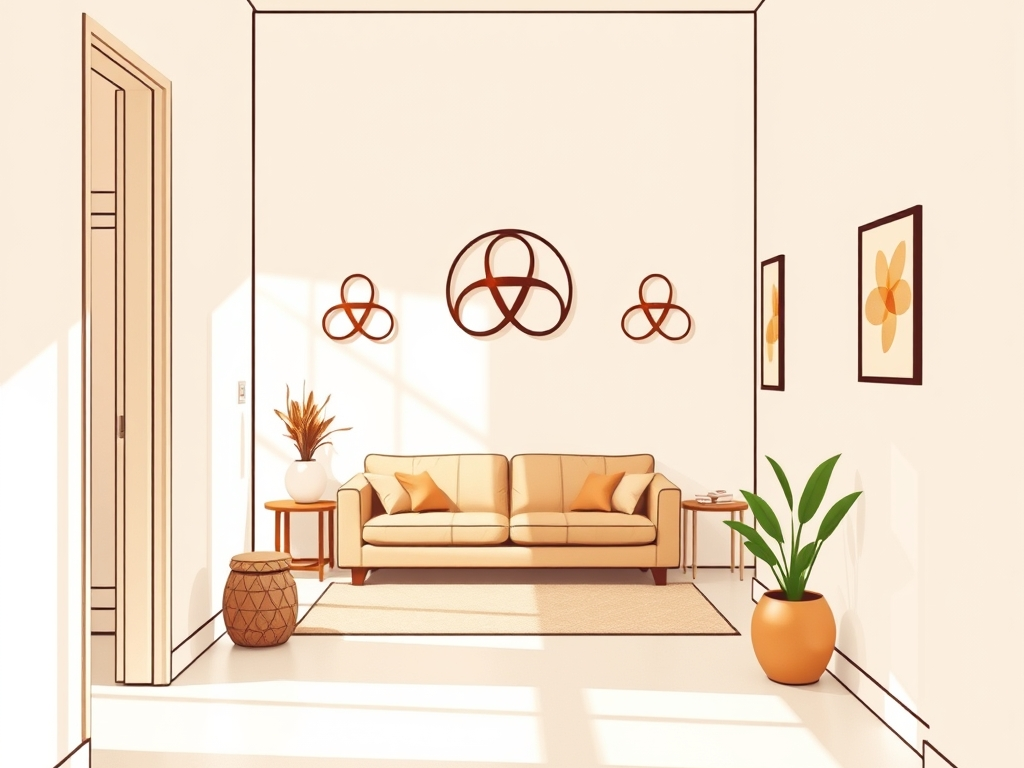
In the bagua map, the relationship area sits in the southwest corner of a home or room, associated with the earth element and the trigram Kun. In popular feng shui it is the corner where you place pairs of objects, pink accents, and romantic symbols to improve your love life. The popular version is mostly decoration. The useful version is a reminder that spaces shape how people relate: the corner where partners sit, talk, and rest can support connection, and its condition often reflects the attention a relationship receives.
This article explains what the relationship area actually represents, how to work with it honestly, and which symbols earn their place. If the map is new to you, read What Is the Bagua Map? and How the Bagua Map Applies to Your Home first.
What the Southwest Corner Represents
The southwest corner is traditionally linked to the mother archetype, partnership, and the receptive qualities of earth: stability, care, and long-term support. In a home, the area is read as the relationship sector because it symbolizes the space where a partnership is nurtured. In a room, the same logic applies: the southwest of a living room or bedroom becomes the zone that supports connection.
It is important to hold the symbolism lightly. The corner does not control your relationships; it reflects and supports them. A cluttered, ignored southwest corner is a useful prompt to notice how much attention the relationship gets, not a cause of breakups. For the deeper meaning of the bagua areas, read How the Bagua Relates to Different Areas of Life.
What the Area Needs to Function
The relationship area functions best with the same qualities a relationship needs: calm, openness, and enough structure to feel safe. Start with the physical basics. Keep the corner reasonably clear, because clutter carries the message that this part of life is neglected. Provide comfortable seating for two if the space allows, because the layout of a room literally shapes how often partners sit together. Balance the light so the corner feels warm rather than harsh.
The earth element favors warm, grounded tones and textures: terracotta, soft beige, ceramics, and stone. You do not need to redecorate; one or two earth-toned objects can carry the cue. For the element behind the area, read Earth Elements and Stability in a Home.
Which Symbols Actually Help
Symbols help when they change behavior or attention, not when they sit inert. The most effective relationship symbols are functional pairs:
- Two chairs angled toward each other, which invites conversation.
- A pair of lamps or candles, which creates balanced evening light.
- A shared object, such as a book, a board game, or a photo, that points to joint activity.
- Artwork that depicts connection, chosen because both partners like it.
- One plant, which adds the living quality that static decor lacks.
Notice what these have in common: they are real objects with real functions. A pair of mandarin ducks can be charming, but it does nothing unless the room also gives the relationship a place to happen. For choosing decor with intention, read How to Choose Artwork with Feng Shui in Mind.
A Relationship Area Checklist
Work through the corner in a single session:
- Clear the area of broken, unused, or single-purpose clutter.
- Check that both partners have a comfortable place to sit and talk.
- Balance the light and add one warm, earth-toned texture.
- Place one pair of functional objects or one shared activity item.
- Remove anything that carries a negative association for either partner.
- Use the corner, not just decorate it: sit there for the weekly check-in.
The last item is the one most feng shui advice omits. A relationship area that is only decorated becomes a shrine; one that is used becomes infrastructure. For more on how the map applies room by room, read The Bedroom and Restful Energy.
Common Myths About the Relationship Corner
The first myth is that placing pink objects will attract a partner. Color can set a tone, but it does not recruit people, and the corner works best for people already in a relationship. The second myth is that the corner must be activated with many symbols. One functional pair beats a shelf of figurines. The third myth is that the southwest corner is dangerous or unlucky if ignored. Ignoring it is neutral; the useful reaction is to use it as a prompt for attention, not a source of fear.
The fourth myth is that feng shui can fix a relationship. The corner supports the environment where a relationship happens; it does not replace communication, repair, or shared effort. If the relationship needs work, the corner will not do the work for you. For the honest frame around the whole practice, read Learn Feng Shui Without Superstition and Common Feng Shui Myths.
Adapting the Area to Your Situation
The southwest corner works differently depending on your situation. In a single-person home, the area supports the relationship with yourself and the quality you bring to future partnerships, so care for it the same way. In a shared home where the southwest falls in a hallway or bathroom, use the room-level approach instead: find the southwest of the bedroom or living room and work there. In a home office, the area can support working relationships with clients and colleagues.
The principle survives all these adaptations: one corner of the space carries the theme of partnership, and its condition is a mirror of attention. Keep it calm, keep it used, and keep it honest. For the seasonal adjustments that refresh any area, read Seasonal Adjustments in Home Energy.
FAQ
Does the relationship area work for singles?
Yes, if you treat it as the area of self-care and the quality you bring to relationships rather than a magnet for partners.
Do I need the exact southwest corner?
Approximate is fine. Mark the southwest of the room or home with a simple compass and work with that zone.
Can I use the area for family relationships too?
Yes. The area supports partnership broadly, including close friendships and family bonds, not only romance.
What if my partner dislikes feng shui decor?
Choose neutral, functional pairs that both of you like. The object matters less than the invitation to sit together.