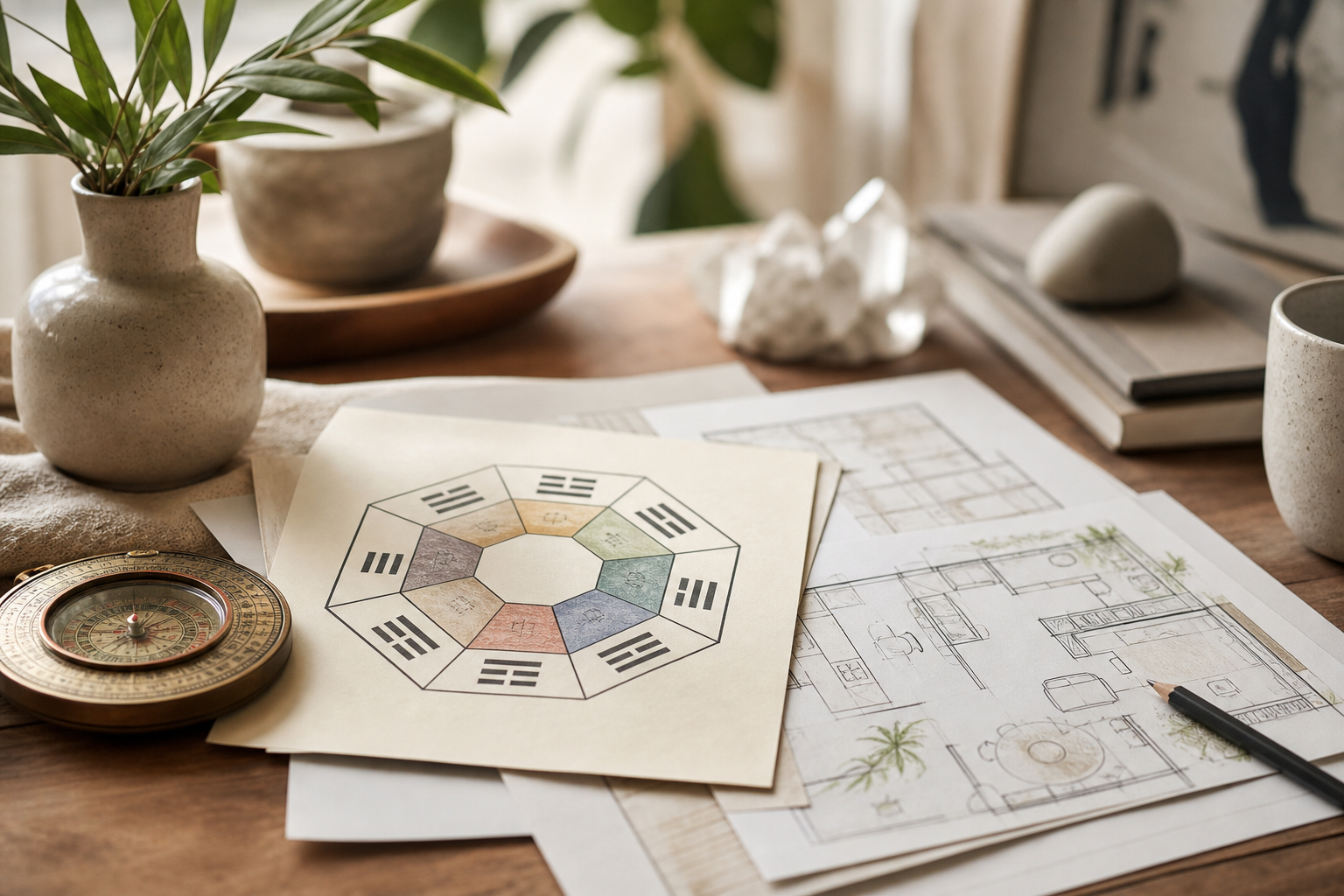
The Bagua map is one of the best-known beginner tools in Feng Shui. It is a framework that divides space into symbolic areas, each associated with a different aspect of life, such as learning, work, relationships, creativity, or support. Beginners often meet the Bagua early because it feels concrete: instead of dealing with abstract theory, you can look at a floor plan, a room, or a defined space and start asking what each section represents.
That said, the Bagua map is not a magical overlay that guarantees results. It is a symbolic reading tool. Its value comes from helping you notice emphasis, neglect, and balance. If used too literally, it can quickly turn into superstition. If used thoughtfully, it can become a structured way to reflect on how a space supports different parts of life.
How the Bagua Map Is Organized
The term Bagua is often connected to eight trigrams from classical Chinese thought, along with a center area. In practical Feng Shui teaching, the map is usually shown as a grid or pattern that divides a space into nine sections. Each section is commonly linked with themes such as career, knowledge, family, abundance, reputation, relationships, creativity, helpful people, and overall center or balance.
These life-area labels are useful orientation points, not literal containers of destiny. A "career" area is not a vending machine for promotions, and a "relationship" area is not a switch you can flip. The labels are symbolic prompts. They suggest a zone of reflection: what does this part of life look like right now, and does the space express neglect, support, confusion, or intention around it?
Different Ways People Apply Bagua
One reason beginners get confused is that Bagua is taught in more than one way. Some approaches use compass directions and orientation. Others use a more fixed entry-based method that aligns the map to the front of the space. Both are common in English-language beginner materials, and many people are first introduced to one without realizing another exists.
The important beginner lesson is not to pretend there is one universal rule when methods differ. If you are learning one approach, stay consistent long enough to understand its internal logic. Jumping between methods and mixing instructions from multiple systems usually creates more confusion than insight. A steady learning method will teach you far more than random online shortcuts.
A Simple Room-Level Example
Imagine you apply the Bagua map to a home office. One section of the room corresponds, in the method you are using, to learning and reflection. That area currently contains a broken chair, tangled cables, and boxes you never unpacked. A beginner does not need to claim cosmic damage here. The symbolic reading is already meaningful: a zone connected with learning is physically expressing neglect and interruption.
A grounded response would be to clear the area, restore working furniture, and place something that genuinely supports study, such as a reading lamp, notebook shelf, or reference materials. The point is not to force a mystical result. The point is to bring the symbolism and the use of the room into better alignment. This is the kind of Bagua practice that remains thoughtful instead of theatrical.
How to Use Bagua Without Becoming Rigid
Beginners often worry about doing the overlay "perfectly." In most homes, floor plans are irregular, furniture shifts, and rooms serve more than one purpose. If you turn the Bagua map into a stress test, you miss the whole point. It is better to use it as a reading frame than as a punishment system.
Ask practical questions. Which sections of the room feel active and well cared for? Which feel ignored? Which carry a mismatch between their symbolic theme and the way the space is actually used? This kind of questioning helps you see patterns. It is far more useful than searching for a one-item cure for every life area.
FAQ
Do I need a perfect square room to use Bagua?
No. Many real homes and rooms are irregular. Beginners can still work with the overall layout and use the map as a structured guide rather than as a rigid geometry problem.
Which Bagua method is the right one?
Different schools teach different approaches. What matters at the beginner stage is choosing one method, understanding it clearly, and not mixing unrelated instructions without context.
Can I use Bagua on one room instead of my whole home?
Yes. Many beginners learn more by applying Bagua to one room first because the exercise stays manageable and easier to observe.
Does each area guarantee results in that part of life?
No. The life-area labels are symbolic associations. They support reflection and spatial reading, but they do not guarantee fixed personal outcomes.
Where to Go Next
Next, read How Bagua Relates to Different Areas of Life to see how those symbolic labels are commonly interpreted. Then continue with How to Start Learning Feng Shui Without Superstition or Fear to keep your study grounded. You can also browse all Feng Shui articles from the archive.