Earth is the element people usually notice only when it is missing. A room with plenty of Earth feels settled: the furniture is anchored, the colors are warm, and the space does not ask for your attention. A room without Earth can feel floaty, loud, or unfinished, even when it is clean. In Feng Shui, Earth is associated with stability, nourishment, and the center, which makes it a natural element for homes and especially for shared rooms. This article explains how to use Earth qualities in a home without making it feel heavy, starting from the placement framework in The Five Elements in Feng Shui Placement.
What Earth Represents
Earth in the five-element system is the element of late summer and of the center: the season when growth matures into harvest and the point where the other directions meet. Its qualities are steadiness, patience, and nourishment. A room with strong Earth feels like a place where people can stay for a while, because nothing in it demands constant rearrangement.
Those qualities are useful in exactly the rooms where people relax, eat, and talk. The living room, dining area, and bedroom all benefit from a sense of stability, because each one hosts activities that need time. The center of the home is also traditionally linked to Earth, and its condition is worth reviewing when a home feels unbalanced, a connection explained in The Center of the Home and Its Meaning.
Where Earth Shows Up
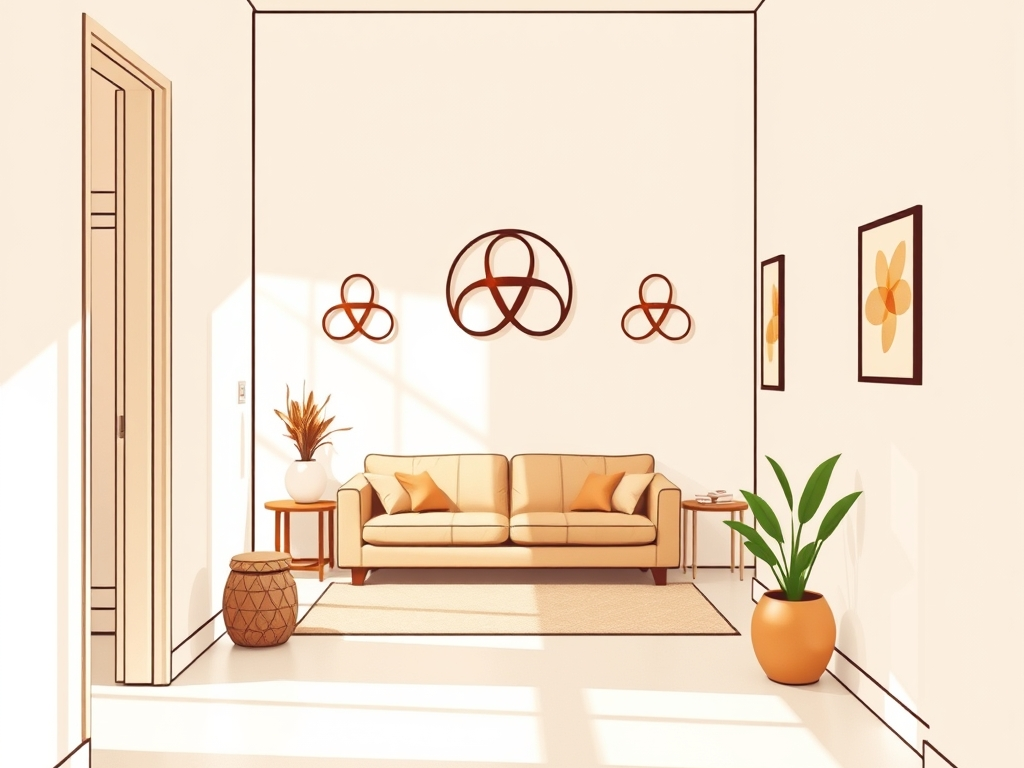
Earth appears in materials, colors, shapes, and weight. Ceramic vases, stone tiles, terracotta, clay pots, and plaster walls are direct Earth materials. Warm neutrals such as sand, ochre, cream, and soft brown carry the color. Square and horizontal shapes express the element, which is why a low, square coffee table feels more grounded than a tall, thin one.
Weight matters in a practical way. A room that feels scattered often improves when one large, solid piece of furniture anchors the space, because the eye has somewhere to rest. The reverse is also true: a room with too many heavy pieces can feel dense and difficult to move through. The goal is a single grounding point per room, not a house full of stone. For the general principle of arranging a room around one focal point, see The Command Position in a Room.
A Grounding Checklist for Any Room
When a room feels unstable or scattered, work through this checklist:
- Identify one large, solid anchor, such as a sofa, a wooden bed frame, or a substantial table.
- Check the center of the room: if it is blocked by clutter, clear a small path through it.
- Add one Earth material, such as a ceramic bowl, a stone tray, or a terracotta pot.
- Soften the color palette with one warm neutral, even if the rest of the room is bold.
- Check the horizontal lines: a low shelf or a wide mirror can ground a room with very tall furniture.
- Test the room by sitting in it for five minutes and noticing whether the space feels settled.
The checklist is reversible and low-cost, which makes it easy to test. If the room feels heavier after an Earth change, the change was too large, and a smaller version may work better. This testing habit is central to the practical approach in What Makes a Space Feel Balanced.
Common Misconceptions About Earth
The first misconception is that Earth requires brown and beige everywhere. Earth is a quality, not a color scheme; cream, sand, stone gray, and even softened green can carry it. The second misconception is that Earth makes a room boring. Stability is not the same as emptiness, and a grounded room can still contain pattern, color, and personality. What changes is the arrangement: objects feel placed rather than scattered.
The third misconception is that Earth belongs only on the ground or in the center of the home. Earth materials work anywhere, and a small ceramic piece on a shelf can settle a corner that feels unfinished. The element is also connected to the other four elements through the cycle, so the real question is always what the room currently has too much or too little of. That balance is explained in How to Use the Five Elements in Daily Life and The Cycle of Creation and Control.
Earth in Apartments and Small Rooms
Earth can feel difficult in an apartment, because the materials that express it, such as stone and terracotta, are often heavy and permanent. The solution is to use small, portable versions: a ceramic vase, a clay dish on the entry table, or a warm neutral rug. Apartments also benefit from the element because they tend to have lighter construction, and a little weight in the decor makes the space feel more secure. Practical portable adjustments are covered in Feng Shui for Apartments.
Earth also responds well to seasonal review. In summer, when Fire is strong, additional Earth can help a room feel calmer; in winter, when Metal and Water are more present, a warm earth tone can soften the coolness. Adjusting one or two accessories per season keeps the element active without turning the room into a project. The same seasonal logic appears in Seasonal Adjustments in Home Energy.
A simple test for Earth in a room is to sit there at the end of the day and ask whether it feels like a place you can land. If your shoulders stay tight or your eyes keep moving, the room may need one anchoring element: a substantial lamp, a low table, or a warm neutral surface that gives the eye somewhere to rest. The test is not about decorating; it is about noticing whether the space supports the activity of staying still. Over time, the rooms that pass the test are usually the ones with a clear center, a clear path, and one or two grounded objects that carry the rest of the design.
FAQ
Does Earth mean my home must be neutral colored?
No. Earth is a stabilizing quality expressed through materials, shapes, and weight, not a strict color palette.
Where does Earth belong in a home?
Earth is linked to the center, but grounding materials work in any room that feels scattered or unsettled.
Can too much Earth make a room feel heavy?
Yes. The element helps in small amounts, so choose one anchor and one Earth material per room.
Is Earth more important than the other elements?
No element is more important; Earth simply describes the stabilizing quality that balances the other four.