Symmetry is one of the fastest ways to make a room feel calm, and it costs nothing. Two matching lamps, a bed centred on the wall, a table balanced by chairs, these arrangements read as order without a word being said. The traditional view of space has always appreciated balance, and symmetry is its most visible expression. But the point is not perfect mirroring; it is the feeling of weight distributed evenly. For the wider idea of balance, start with What Makes a Space Feel Balanced.
This article explains how symmetry works in a room, where it helps, and why lived-in rooms need a little asymmetry to feel real.
Why Symmetry Reads as Calm
The eye scans a room constantly, even when the mind is elsewhere, and an uneven room asks the eye to keep working. Two lamps of different heights on either side of a bed create a small, repeated question; two matching lamps close the question. Symmetry reduces that background scanning, which is why symmetrical rooms feel quieter. The calm is not mystical; it is attention saved.
This is also why the strongest symmetry works in the places where people rest and sit: the bed, the sofa, the dining table. The places where the body stays still benefit most from a balanced field. For the restful version of this idea, read The Bedroom and Restful Energy.
Where Symmetry Helps Most
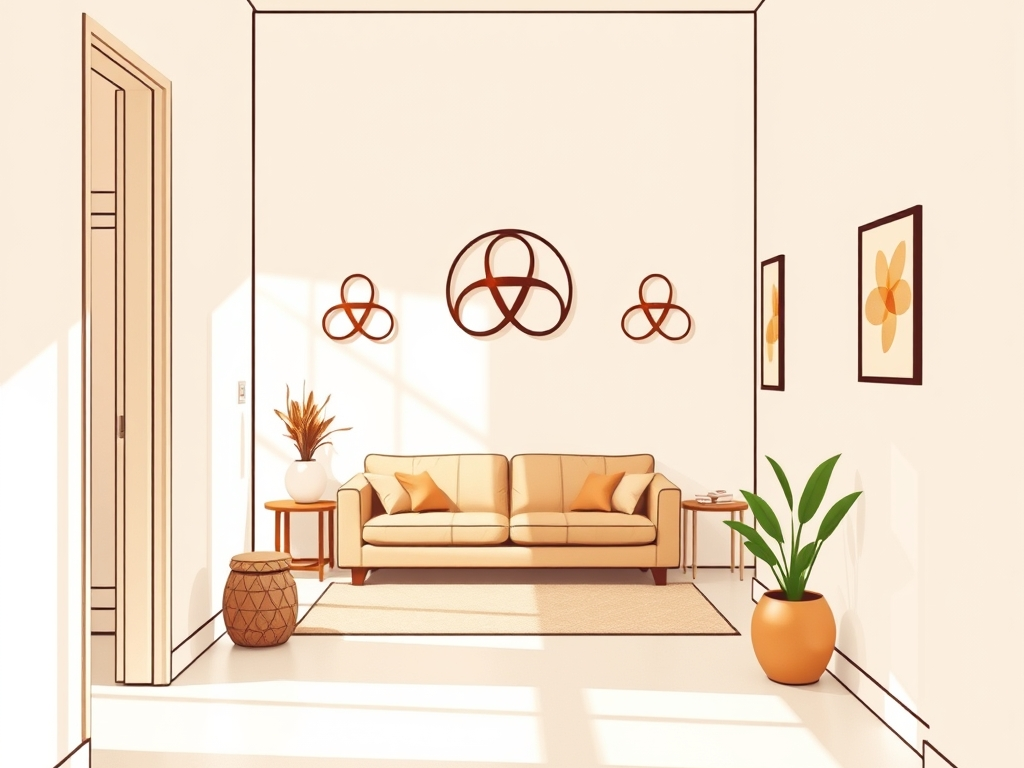
Start with the three anchors of a room: the bed or sofa, the main table, and the primary wall. A bed with a lamp on each side and a centred headboard anchors the whole room. A sofa with matched ends and a coffee table within reach does the same. A dining table with balanced chairs turns a meal into a settled event. These three anchors carry most of the calm a room can offer.
Secondary symmetry is optional: matching shelves, paired plants, or a balanced arrangement of artwork. The anchors matter most, and they are where a small change gives the largest effect. For the anchoring furniture lines, read Furniture Lines and the Flow of a Room.
The Weight of Asymmetry
Perfection is not the goal. A room that is perfectly mirrored can feel like a showroom, stiff and unused. The tradition values balance, not rigidity, and the difference matters. Symmetry provides the calm; small asymmetries provide the life: a book left on the table, a plant that leans, a child's drawing on the wall. The room should be symmetrical in its bones and lived-in in its details.
The practical rule is to balance the large elements and allow the small ones to vary. Large imbalance reads as disorder; small variation reads as life. For the shape and feel of rooms, read The Shape of a Room and the Feel of a Space.
A Symmetry Checklist
- Centre the bed or sofa on its main wall.
- Balance the sides: matching lamps, tables, or plants where possible.
- Keep the main table balanced, with chairs and settings even.
- Check the room's weight, dark and heavy objects spread evenly.
- Leave one small asymmetry per room, something clearly alive.
The checklist takes an afternoon and usually requires no purchases. If the room already has anchors, you may only need to rearrange what exists. For the elements behind the weight, read The Five Elements in Feng Shui Placement.
Symmetry With a Shared Life
Rooms shared by two people have a natural tension between two sets of preferences, and forcing perfect symmetry can erase one person's presence. The resolution is balance at the room scale, not the object scale. If one side of the bed has a reading lamp and the other has a plant, the room can still feel even if the two sides are not identical. The aim is that no single corner carries all the weight, visually or practically.
This is also why symmetry should never be enforced at the cost of use. A chair that blocks the path for the sake of a matched pair is not calm; it is inconvenient. For the flow that keeps a room usable, read The Hallway and How Energy Moves.
Keeping the Practice Simple
Symmetry is a habit more than a project. Each time you rearrange a room, start by balancing the anchors, then allow the details to fall as they will. The habit takes minutes and keeps the room from drifting into visual noise. Once a season, review the main wall and the main table, the two places where balance does the most work.
For the weekly version of this maintenance, read A Weekly Feng Shui Reset.
The bedroom is where symmetry earns its keep most visibly, because the bed is the largest anchor in the room and the sides of the bed frame the final and first moments of the day. Two matching lamps, or even two balanced surfaces of different kinds, give each side of the bed an equal presence, and the equality reads as rest. The small asymmetries can stay close at hand: one side may hold a book and the other a glass of water, and the room remains calm because the large structure is even. When the anchors are balanced, the details are free to be personal without making the room feel lopsided.
Balance also applies to the visual weight of the whole room, which is easy to overlook in a space that has no obvious pairings. A large dark wardrobe on one wall and a light empty wall on the other create an imbalance that no matching lamps can fix, and the fix is usually practical: move the heavy piece, add a large light surface opposite it, or break the heavy wall into sections. The eye reads the room as a whole, and the whole needs an even distribution of weight, not just symmetry around one anchor.
FAQ
Does every room need symmetry?
No. The anchors, bed, sofa, and main table benefit most; the rest can follow your own taste.
Can a room be too symmetrical?
Yes. Perfect mirroring can feel stiff; leave small asymmetries so the room feels lived in.
Do I need to buy matching furniture?
No. Balance weight and visual size with what exists; matching is only one way to achieve it.
Is symmetry part of traditional feng shui?
Balance is central to the tradition, and symmetry is its most visible form, though the deeper principle is even distribution of weight and attention.