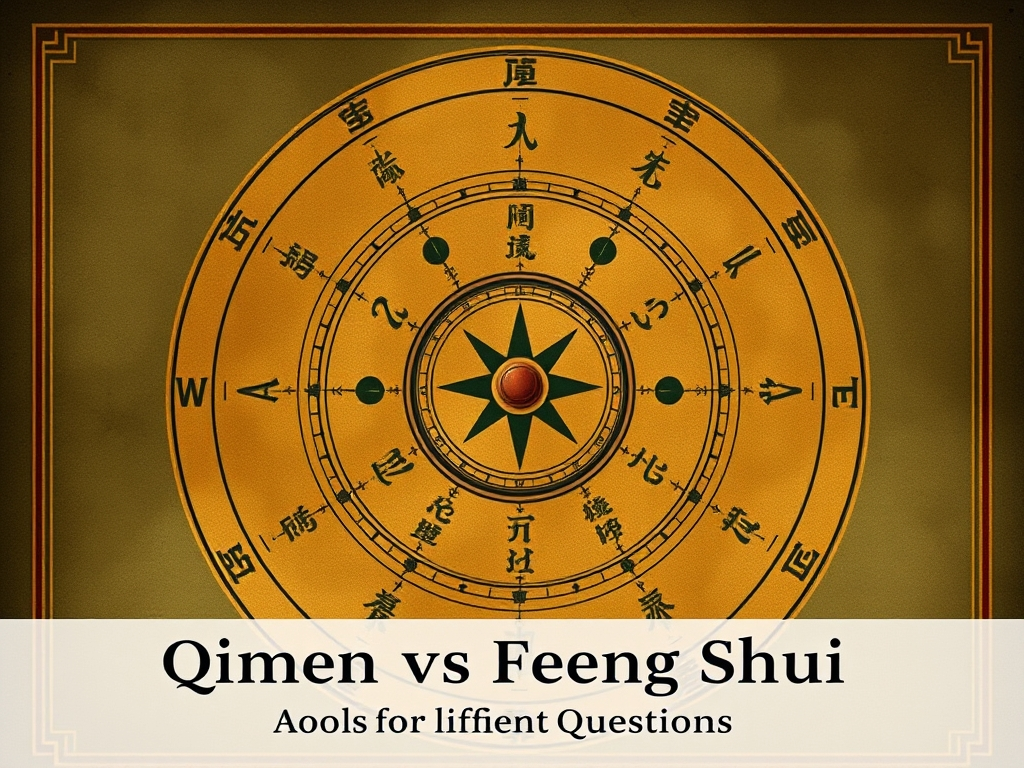
Qimen Dunjia and Feng Shui are often mentioned together, but they are different tools built for different questions. Feng Shui analyzes the energy of a place and how that space supports the people living or working in it. Qimen Dunjia analyzes a moment in time and the opportunities available at that moment for a specific decision. One is about the environment, and the other is about timing and choice. This article compares the two systems, starting with the Qimen foundation in What Is Qimen Dunjia? A Grounded Introduction.
What Feng Shui Does
Feng Shui looks at a physical space: its layout, orientation, light, airflow, and the placement of objects. The goal is to understand how the space supports the activities that happen there, such as rest in a bedroom, focus in an office, or conversation in a living room. Feng Shui guidance tends to be durable: once you arrange a room well, the arrangement works for you day after day. The practical approach to evaluating a home is described in What Is Feng Shui?.
Because Feng Shui works through the environment, it is the right tool when your question is about a place. Should the desk face the door? Is the bedroom arranged for better rest? Is the clutter in the career area of the bagua affecting your work? These questions are spatial, and a Feng Shui review addresses them directly.
What Qimen Dunjia Does
Qimen Dunjia builds a chart for a specific moment and uses that chart to evaluate a decision or an opportunity. The chart organizes nine palaces, doors, stars, and deities into a snapshot of conditions, and the reading describes which directions, activities, and timings are relatively favorable in that window. The structure of the chart is explained in The Nine Palaces in Qimen Explained, and the meaning of the doors in The Eight Doors in Qimen and What They Mean.
Qimen is the right tool when your question is about timing and choice. Should I launch the project this week or next? Should I negotiate now or wait? Which of two job offers deserves the next conversation? These questions depend on the moment, and Qimen is designed to compare options and windows rather than to rearrange a room.
How the Two Systems Complement Each Other
In practice, the two systems work well together because they answer different layers of the same situation. A person might use Feng Shui to make their home office supportive and then use Qimen to choose the best window for an important interview. The environment question and the timing question are separate, and each system handles the layer it understands. A fuller map of how the major systems relate is available in How the Major Chinese Metaphysics Systems Fit Together.
This division of labor also prevents a common confusion: people expect Feng Shui to tell them when to act, or expect Qimen to fix the energy of a room. Neither system works that way. A beautiful room does not create a good moment, and a favorable chart does not repair a dysfunctional space. Matching the tool to the question is the first step toward a useful reading.
A Quick Guide to Choosing the Tool
- Question about a room, building, or layout: use a Feng Shui review.
- Question about a moment, window, or decision timing: use a Qimen reading.
- Question about both: use Feng Shui for the space and Qimen for the timing.
- Question about a recurring pattern in your life: start with a structural system such as BaZi, as compared in Qimen vs BaZi: Timing vs Structure.
- Question about direction or travel: Qimen and its direction framework are described in Direction and Movement in Qimen.
The guide is deliberately simple. Most people do not need both systems for every question, and using one clear tool for one clear question gives better results than mixing systems without a plan.
Common Misconceptions
The first misconception is that Qimen is a stronger version of Feng Shui. They are not ranked; they address different questions, and either can be the right tool depending on the situation. The second misconception is that Feng Shui advice should be followed exactly as written without considering the actual room; the same practical caution applies to Qimen charts, which are described as decision support rather than certainty in Qimen Symbols Without Superstition.
The third misconception is that you need both systems mastered before you can use either. A focused reading with one well-understood system is usually more helpful than a vague reading that mixes several. If you are new to Qimen, start with the grounded introduction and build from there, as suggested in A Beginner's First Qimen Chart.
A Quick Side-by-Side in Practice
Imagine you are unhappy with your home office and also deciding when to launch a project. A Feng Shui review of the office would look at the desk position, the light, the clutter, and the paths through the room, and it would suggest changes you can keep for years. A Qimen reading would look at candidate launch dates and describe which window supports communication and visibility. The two answers do not compete; they handle different parts of the same plan. You fix the room so the space supports the work, and you choose the window so the work starts under better conditions.
This division also shows up in the vocabulary. Feng Shui talks about rooms, directions, elements, and placement; Qimen talks about palaces, doors, stars, and moments. When you hear both vocabularies in one conversation, keep the questions separate: what does the space need, and what does the timing support? The practical comparison of reading types is covered in BaZi Report vs Qimen Brief, which applies the same discipline to choosing a reading product.
FAQ
Can I use Qimen to improve my home?
Not directly. Qimen is about timing and decisions; for the physical space itself, a Feng Shui review is the matching tool.
Is Feng Shui part of Qimen?
They share background theory, but they are separate systems with different charts, methods, and questions.
Which should I learn first?
Choose the one that matches your question. If you care about spaces, start with Feng Shui; if you care about decision timing, start with Qimen.
Do the two systems ever contradict each other?
They can point in different directions because they address different layers, but a careful reading usually finds both compatible.