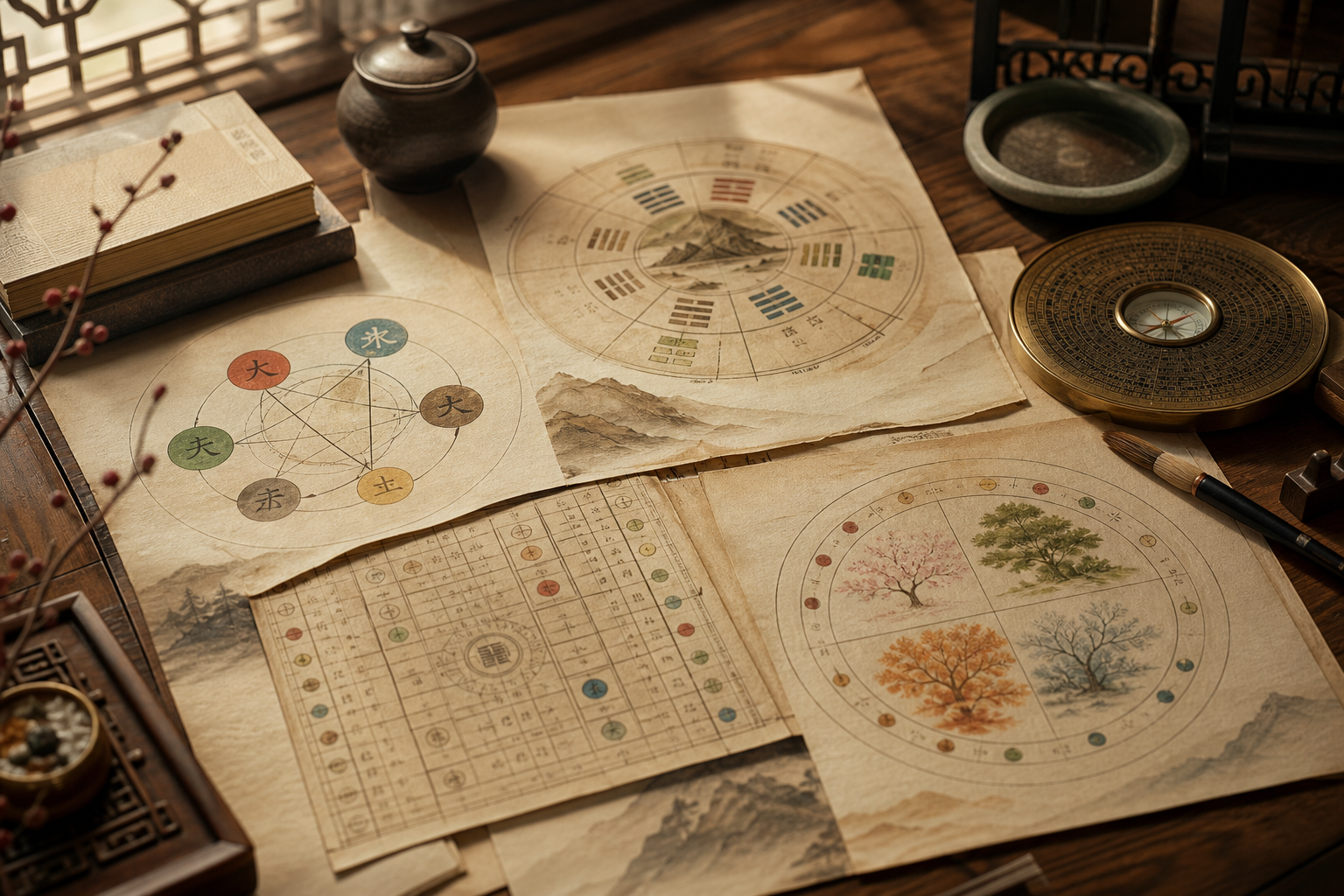
One of the hardest parts of beginning Chinese metaphysics is figuring out what each system is actually for. Many readers encounter BaZi, Feng Shui, Qimen Dunjia, and daily timing content all at once. The result is often a blur. Everything sounds related, but the roles remain unclear. A better start is to treat the systems like different lenses. They belong to the same world of symbolic and cyclical thinking, but they do not answer the same question.
That difference matters because confusion grows when a tool is used for the wrong purpose. A destiny chart is not a substitute for environmental reading. A timing method is not a replacement for structural life analysis. The systems fit together best when their boundaries are respected. Once you understand what each lens is designed to reveal, the whole subject becomes much easier to navigate.
BaZi Reads Structure and Life Timing
BaZi, often called Four Pillars, is centered on birth data. It is used to read structural tendencies, recurring themes, and longer-term life timing. In simple terms, it asks what kind of person is carrying this life, what kinds of patterns are likely to repeat, and how major cycles may change the pressure or support around them. BaZi is not mainly about room layout or short-term direction. Its home territory is personal pattern across time.
This is why BaZi attracts readers who want to understand destiny themes, life phases, career pressure, relationship timing, and the deeper structure beneath repeated experience. If that area interests you specifically, the BaZi section is the place to go deeper. Here we are simply locating it inside the larger map.
Feng Shui Reads Space and Environmental Support
Feng Shui is concerned with place. It asks how environment gathers, redirects, or weakens support. A home is not treated as neutral. Layout, entry, flow, form, and placement all influence how a space feels and functions. Feng Shui becomes especially useful when a person wants to understand why one environment supports calm, focus, or relationship more naturally than another.
Because Feng Shui works with space, it should not be confused with destiny reading. A room cannot tell you everything about a life cycle, and a chart cannot tell you whether your bedroom layout is draining your rest. The systems complement each other by focusing on different layers of reality.
Qimen Dunjia Reads Moment, Direction, and Strategic Fit
Qimen Dunjia is often approached as a strategic timing method. It is used to compare options, assess moment quality, consider direction, and support decision-making where timing matters. Beginners sometimes find it more complex because the chart language can be unfamiliar, but its purpose is practical: which move fits this moment better? Which direction or strategy carries better support now?
This makes Qimen different from BaZi. BaZi may explain why a season of life feels compressed. Qimen may help compare what to do next inside that season. The two systems can cooperate, but they are not duplicates.
Daily Guidance Tracks Rhythm More Gently
Daily guidance is often the softest entry point. It pays attention to rhythm, atmosphere, seasonal flow, and the feel of a day or week. It is less about deep structural decoding and more about pacing. For many modern readers, this is one of the most accessible ways to start because it connects directly to lived experience.
That also makes it a good bridge system. It helps people experience timing before they understand every technical layer behind it. In that sense, daily guidance can prepare a reader for more formal study later.
Why the Systems Work Better Together Than Alone
These systems fit together because human life has more than one layer. There is the person, the place, the moment, and the longer cycle. Chinese metaphysics developed multiple lenses because one lens cannot read everything well. Once beginners accept that, the subject becomes less intimidating. You do not need one totalizing answer. You need the right tool for the right question.
If you want the larger worldview beneath all of them, return to What Is Chinese Metaphysics?. If you want a more skeptical and grounded learning path, continue with How to Study Chinese Metaphysics Without Superstition.
FAQ
Which system should I start with?
Start with the question you actually care about most: life pattern, environment, decision timing, or daily rhythm.
Do I need to study every system?
No. Many readers benefit from understanding the map without trying to become technical in every branch.
Can the systems contradict each other?
They usually differ more in scope than in meaning. Confusion often comes from using one system for a question it was not designed to answer.
What should I read next?
Read How to Study Chinese Metaphysics Without Superstition.
Where to Go Next
Continue with How to Study Chinese Metaphysics Without Superstition, Chinese Metaphysics vs. Western Astrology, and browse the category pages for BaZi, Qimen Dunjia, Bagua & Feng Shui, and Daily Guidance.