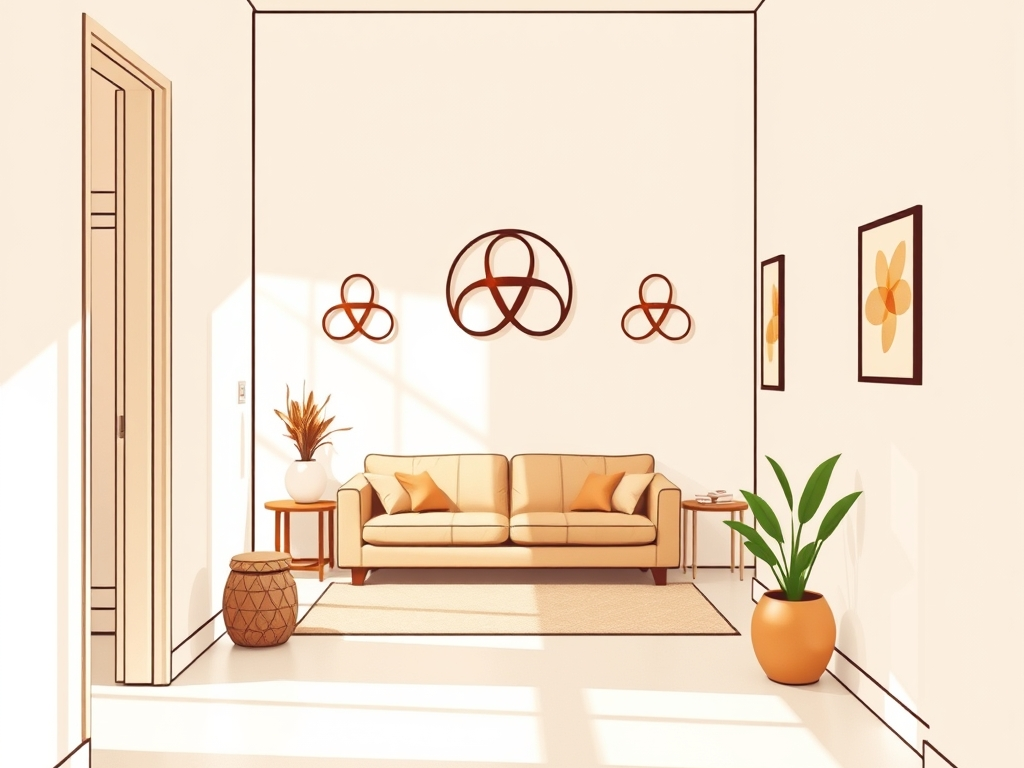
Feng shui is often discussed in terms of sight: lines, views, and arrangement. But sound moves through a home just as surely as light and air, and it shapes how rooms feel from the moment you step in. A hallway that echoes, a kitchen that clatters into the living room, a bedroom that carries the street's noise, all of these change the experience of a space. The traditional practice pays attention to sound as part of the home's energy, and the modern version has a name for it: acoustics. If you are new to the practice, start with Learn Feng Shui Without Superstition.
This article explains how sound behaves in a home, why it matters for rest and focus, and what to change first when a room sounds wrong.
Sound as Part of a Room
Every room has a sound signature. A room with hard floors, bare walls, and few furnishings rings; a room with rugs, curtains, and books absorbs. The signature is not neutral. The body reads it as energy, and the same room can feel lively or restless depending on how much it echoes. In feng shui terms, sound is one of the ways a room's quality reaches you before you have consciously looked at anything.
That is why two rooms with the same furniture arrangement can feel entirely different, and why acoustic fixes are feng shui fixes. For how the feel of a room is built, read How to Evaluate a Room Before Rearranging.
Where Sound Gets Loud
Most homes have predictable noise points. Naming them turns a vague discomfort into a fixable list.
- Hallways and staircases, which channel sound from room to room.
- Kitchens, where hard surfaces and appliances meet.
- Open-plan areas, where one activity carries everywhere.
- Bedrooms, where street noise arrives at the quietest hour.
- Windows and doors, the thin edges between inside and outside.
The list gives you a map of the home's sound. For how the hallway shapes the movement of energy, read The Hallway and How Energy Moves.
Soft Fixes Before Structural Ones
Most sound problems in a home are solved with soft materials, not builders. Work through the cheapest fixes first.
- Add a rug to the room that rings the most.
- Hang curtains that actually cover the window area.
- Fill a bookshelf with books; shelves absorb far more than they reflect.
- Add a cushion or upholstered seat to a hard corner.
- Close doors at the loudest times of day.
The sequence changes the signature of a room without any structural work. For how materials and elements shape a space, see The Five Elements in Feng Shui.
Sound and Rest
The bedroom is where sound matters most, because rest is the room's only job. If the bedroom carries noise, address it before any other adjustment: heavier curtains, a rug beside the bed, a white-noise layer if needed, and a door that closes fully. The tradition treats the bedroom as the home's rest point, and rest is largely an acoustic achievement.
For the rest of the room's setup, read Bedroom Feng Shui Basics.
Sound and Focus
In work areas, sound is either a support or a tax. A home office that receives the kitchen's clatter and the hallway's footsteps costs focus all day. The fixes are the same soft materials, plus one deliberate choice: put the desk where the room is quietest, which is usually away from the door and the shared wall.
For the desk position itself, see Home Office Feng Shui for Focus.
Making Sound a Design Choice
Sound does not have to be neutral; it can be designed. A home can choose quiet corners for reading and lively corners for gathering, and the materials can say which is which. The goal is not silence everywhere but clarity: each room sounding like what it is for. That is the feng shui of sound, and it is within reach of any home.
For how the wider layout supports these choices, read Furniture Lines and the Flow of a Room.
Sound also travels through the home's plan, not just its rooms. A kitchen at the centre of an open plan carries its noise everywhere, while the same kitchen behind a closed door keeps its energy contained. When the layout allows, the quietest room should sit farthest from the loudest one, which is why bedrooms are usually placed away from kitchens and living rooms in well-designed homes. If your home cannot be rearranged, the doors are the next best tool: closing one door changes the acoustic map of the whole floor, and it costs nothing to try.
A final note: sound is also time. A home that is quiet at midnight and loud at dinner has a rhythm, and the rhythm can be designed too. Some families choose quiet hours, some choose music hours, and some let each room follow its own clock. The feng shui of sound is not a fixed quietness but a fit between the sound and the moment, so the practice ends where the household's actual life begins. Listen, adjust, and let the home sound like itself.
How to Test a Room's Sound
Before spending money, measure the room's sound with your own ears. Stand in the centre, close your eyes, and listen for thirty seconds, then note the three loudest things you hear. Do the same in the doorway and at the window. The exercise shows where the sound enters and where it lands, which is the information the fixes need. A room that rings will show up as a humming quality in the silence; a room that absorbs will feel soft even when nothing is playing.
The test is also a way to check progress. After adding a rug, curtains, or books, repeat the thirty-second listen and compare. Most people can hear the difference before they can describe it. The same method works for any room in the home, and it trains the ear to treat sound as a design material rather than background noise, which is the shift at the heart of this practice.
FAQ
Does sound really count as feng shui?
Yes. The practice has always included the felt qualities of a space, and sound is one of the strongest of those qualities.
What is the cheapest way to fix a ringing room?
A rug and curtains, followed by books and upholstered furniture; soft materials are the core of acoustic fixing.
Should every room be quiet?
No. A home needs both quiet and lively rooms; the goal is that each room sounds like its purpose.
Can I fix street noise from a bedroom?
Often, yes: heavier curtains, a rug, a sealed door, and a soft layer of white noise usually reduce it enough to matter.