The Five Elements are one of the core symbolic languages used in Feng Shui. They are Wood, Fire, Earth, Metal, and Water. Beginners often meet them early because they offer a clear vocabulary for describing mood, function, rhythm, and emphasis in a space. The Five Elements are not five substances that must literally appear in every room. They are categories of quality and relationship.
Used well, the Five Elements help you notice whether a room feels sharp or soft, heavy or mobile, quiet or active, warm or sparse. Used badly, they can turn into rigid shopping instructions. The goal is not to force every room into a formula. The goal is to understand how symbolic balance relates to lived experience.
Wood, Fire, Earth, Metal, and Water in Plain English
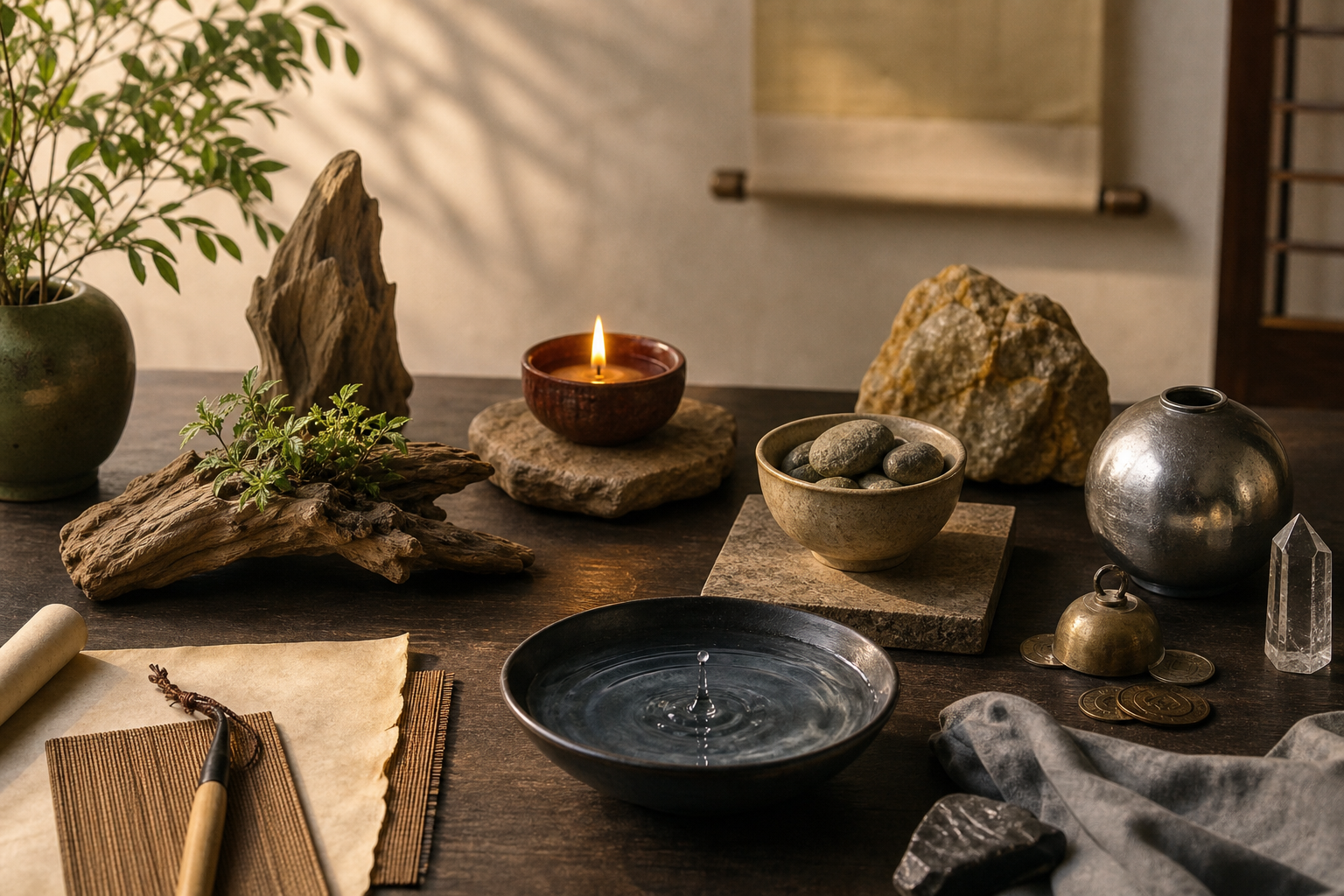
Wood is often associated with growth, extension, planning, and upward or outward movement. In a room, Wood may be suggested by vertical forms, living plants, or the feeling of active development. Fire is linked with brightness, visibility, energy, heat, and strong expression. It often appears through light, bold attention points, or intense visual emphasis.
Earth suggests steadiness, support, containment, and groundedness. It can be felt in stable furnishings, balanced proportions, and visual weight that helps a room feel settled. Metal is commonly associated with structure, precision, clarity, and refinement. It may appear in cleaner lines, sharper order, or materials and forms that feel more exact. Water is linked with flow, depth, adaptability, and quiet movement. In a spatial sense, it often helps beginners think about circulation, softness, and rhythm.
These descriptions are starting points. No one element is "best," and no room needs to become a cartoon version of one symbolic quality. The elements are useful because they help you describe tendencies.
How the Elements Are Used in Interpretation
In Feng Shui, the elements are often read through relationships. A room can feel overly dry and rigid, overly scattered and hot, overly heavy and stagnant, or overly fluid and undefined. The Five Elements help give language to those impressions. They are a way of noticing pattern, not a machine for guaranteed results.
This is where beginner misunderstandings happen. People may hear that a certain area "needs" one element and then start adding objects mechanically. But symbolic support only makes sense in context. If a room already feels crowded, adding more objects in the name of a missing element may make the space worse, not better. The lived function of the room still matters more than a checklist.
An Everyday Balance Example
Imagine a work desk that feels sterile, harsh, and mentally tiring. The lighting is bright but cold, storage is rigidly packed, and the whole area feels sharp and compressed. A Five Elements reading might say the space has strong Metal qualities but not much softness, growth, or ease. That does not mean Metal is bad. It means the current balance may be too narrow for the kind of work being done there.
A moderate response could be to introduce more breathable spacing, a warmer light source, a natural material, or one living plant if the desk setup supports it. The point is not to "fix fate." The point is to create a more workable balance between precision and livability. The elements help the beginner see what the room may be overemphasizing.
How to Keep the Five Elements Practical
When learning, avoid treating every element like a decoration category. Ask instead: what quality is missing here, and what quality is excessive? A room that lacks rest does not need a random object from an online list. It may need slower visual rhythm, less crowding, softer transitions, or better maintenance. A room that lacks structure may not need symbolism first; it may need storage and clearer zones of use.
The Five Elements become powerful when they help you translate an intuitive feeling into a readable pattern. That is much more valuable than collecting item-based cures with no relationship to the room itself.
FAQ
Do I need all five elements in every room?
Not in a rigid visual sense. Some rooms naturally emphasize certain functions and moods. The goal is not equal representation of objects but a workable sense of fit and balance.
Are the elements literal materials?
They can be suggested by materials, colors, shapes, and atmosphere, but in Feng Shui they function mainly as symbolic categories rather than just physical ingredients.
Can one element be too strong?
Yes, in a symbolic sense. A room can feel overly intense, overly flat, overly heavy, or overly sharp. The Five Elements help describe that imbalance in a structured way.
What is the best beginner practice?
Pick one room and describe its dominant qualities before changing anything. Learning to observe clearly is more useful than rushing to add symbolic items.
Where to Go Next
Continue with What Does Qi Mean in Feng Shui? to connect the elements with the idea of flow. Then read What Makes a Space Feel Balanced in Feng Shui? for a practical balance exercise. More related guides are listed in the Feng Shui archive.