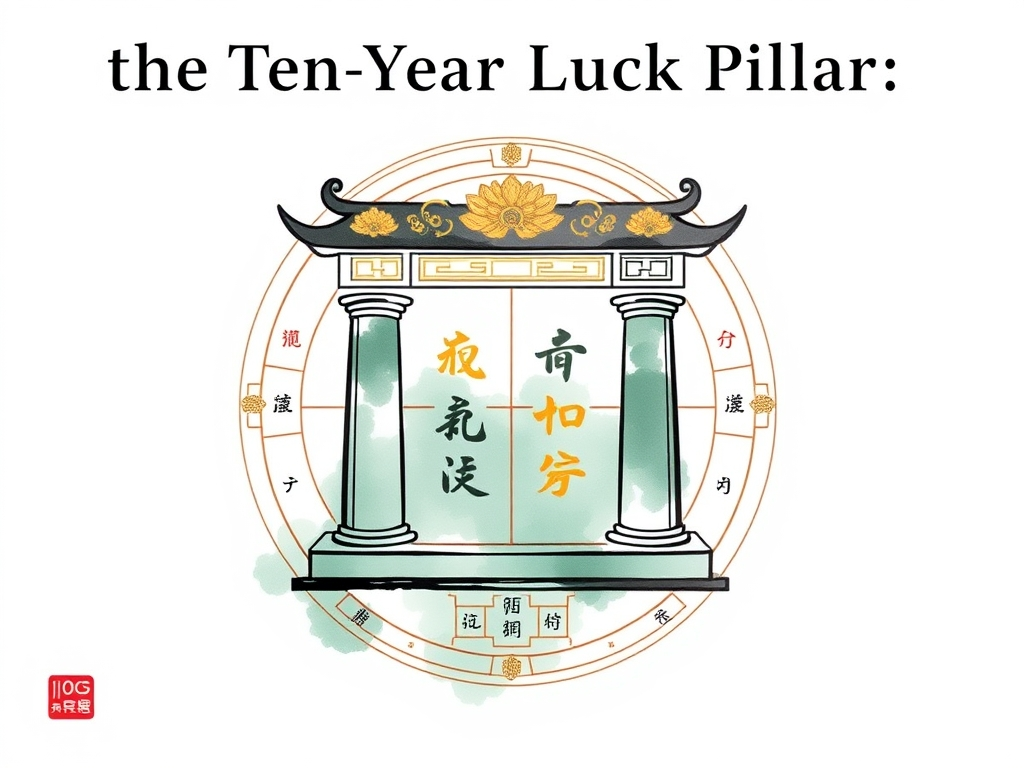
Among the many concepts in BaZi, the ten-year luck pillar is the one that most changes how a reading is used. The birth chart is fixed, but the luck cycle describes the weather of each decade, and that weather determines which parts of the chart are easy to express. Without the luck pillar, a reading is a still photograph; with it, the photograph becomes a film.
The luck pillar is a pair of characters, one stem and one branch, that governs roughly ten years of a person's life. It is calculated from the birth chart and moves in a fixed direction, forward for some charts and backward for others, beginning at an age that depends on the month of birth. The system is deterministic, which means the same chart always produces the same cycle, and that consistency makes the cycle useful for planning.
How the Luck Pillar Is Calculated
The calculation has three parts. First, the reader determines the direction of the cycle from the year stem's polarity: a positive year stem moves the cycle forward through the stems and branches, while a negative stem moves it backward. Second, the starting age is counted from birth to the next solar term boundary in the direction of travel. Third, each decade adds one stem and one branch, producing a series of pillars that run in sequence.
The result is a timeline: childhood, young adulthood, middle age, and later years each sit under a different elemental climate. A person may spend their twenties under a Water pillar and their thirties under a Wood pillar, and the shift explains why energy, interests, and opportunities change even when the underlying chart stays the same. For the base structure behind the calculation, read How a BaZi Chart Works.
What Each Kind of Pillar Tends to Emphasize
Readers describe luck pillars by their dominant element and Ten God relationship to the Day Master. A Resource pillar tends to emphasize learning, support, and preparation. An Output pillar tends to emphasize creation, visibility, and delivery. A Wealth pillar tends to emphasize resources, negotiation, and practical outcomes. An Officer pillar tends to emphasize responsibility, structure, and recognition. A Companion pillar tends to emphasize partnership, peers, and shared effort.
None of these themes is a promise. A Wealth decade does not guarantee income; it makes money-related themes more active, which can mean bigger decisions and clearer lessons rather than easier ones. The practical question is what the decade asks you to practice. For the vocabulary of these relationships, see The Ten Gods in BaZi Explained Simply.
How to Read Your Own Decade
You can build a useful decade map with a short exercise:
- Find the start age and direction of your luck cycle from your chart.
- Write the sequence of pillars for the next three decades.
- Label each decade by its dominant theme: build, learn, manage, serve, or connect.
- Compare past decades with your real history to calibrate the system.
- Note the boundary years, which are often periods of transition and instability.
People are usually surprised by how well past decades match real chapters of their lives, and just as surprised by the mismatches, which teach them how to read more carefully. You can generate your chart and cycle with the BaZi calculator, then check the sequence against Luck Pillars in BaZi and Why Timing Matters.
Common Misconceptions About the Luck Cycle
The first misconception is that a favorable luck pillar means automatic success. The pillar describes support, not delivery; effort, skill, and opportunity still decide the outcome. The second misconception is that an unfavorable pillar means a lost decade. Difficult decades are often the ones that build resilience, and readers frequently find that the most productive work of a life happened under pressure.
The third misconception is that the luck cycle replaces the birth chart. A weak chart under a helpful pillar still needs structure, and a strong chart under a challenging pillar still has resources. The cycle changes emphasis, not identity. For a balanced view of what charts can and cannot do, read What a BaZi Reading Can and Cannot Tell You.
Using a Decade Without Being Controlled by It
The responsible use of a luck pillar is planning. If the current decade favors learning, invest in training and steady practice. If it favors output, schedule launches and visible projects. If it favors partnership, build your network deliberately. The decade becomes a lens for choosing between options, not a script for avoiding effort.
This is especially useful at boundary years, when the old pillar is fading and the new one has not settled. Transitional periods often feel confusing, and knowing that the confusion is structural can reduce anxiety and improve decisions. For more on navigating those transitions, read When to Start, Refine, or Pause and browse the BaZi library.
A Worked Example
A person with a Metal Day Master enters a Water luck pillar in their forties. Water is Metal's Output, so the decade emphasizes expression and production. In their fifties, the cycle moves to Wood, which is Metal's Wealth element, so resource management and practical outcomes move to the foreground. The person uses the forties to publish and teach, and the fifties to manage the results and build lasting structures. The chart never changed; the season did.
That sequence is the entire value of the luck pillar in one paragraph: it helps you match your actions to your season. For more worked readings and terms, browse the BaZi section or start with the basics in What Is BaZi?.
FAQ
Is the luck pillar the same for everyone born in the same month?
No. The starting age and direction depend on the full birth chart, so the sequence differs even for similar charts.
Can a luck pillar change my personality?
It changes which tendencies are emphasized, not the underlying chart. The same person can express different sides in different decades.
Should I make major decisions only in favorable pillars?
No. The pillar is one input; decisions should weigh your skills, values, and real options as well.
How accurate is the starting age of a luck pillar?
It depends on accurate birth data and the solar term boundary. Small date errors near the boundary can shift the whole sequence.