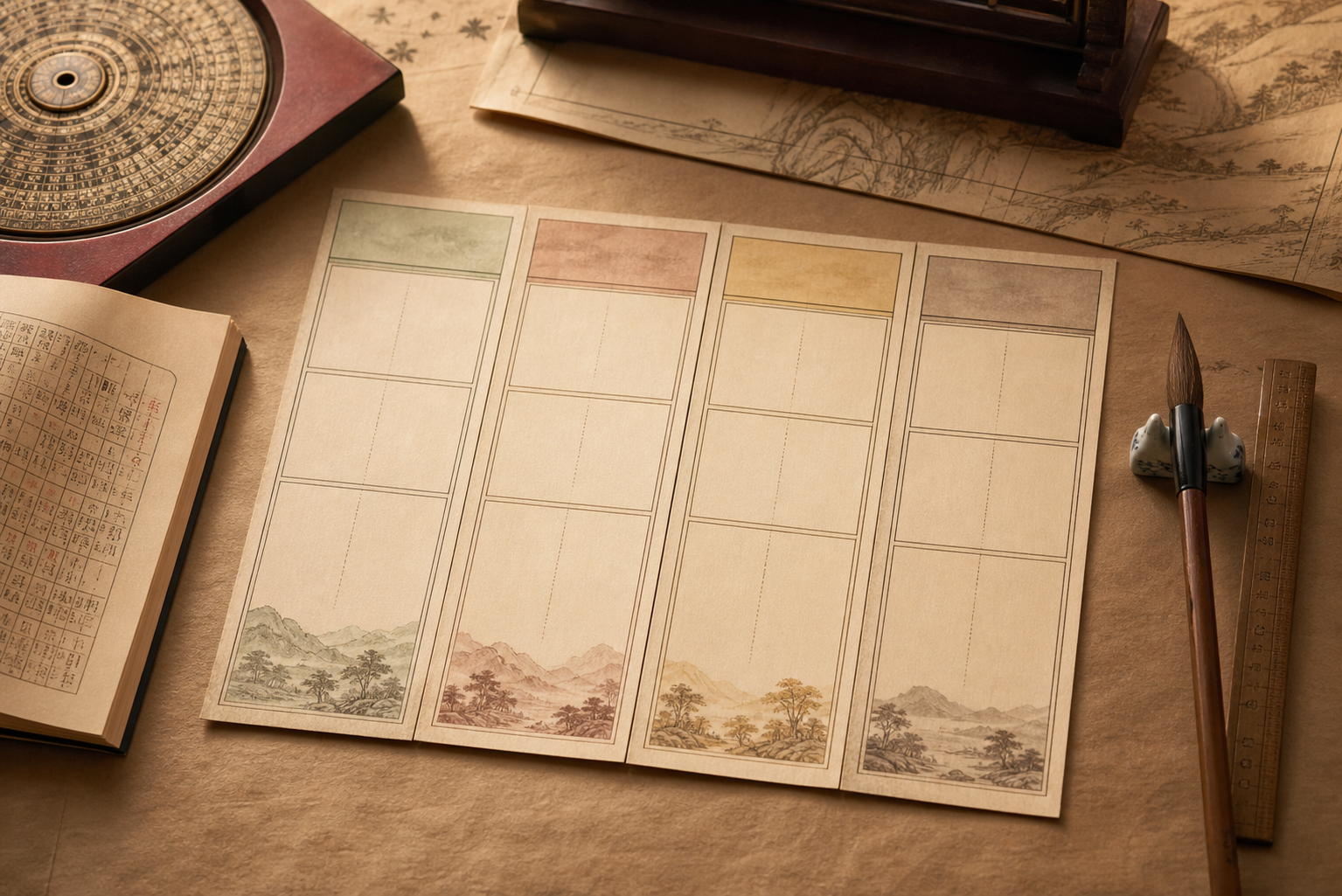
Once someone understands that BaZi is a birth chart system, the next question is usually practical: how does the chart actually work? A BaZi chart is organized into four pillars: year, month, day, and hour. Each pillar contains a Heavenly Stem and an Earthly Branch, and together they create the chart’s structure.
The important thing for beginners is not to memorize every symbolic detail at once. Instead, focus on what each pillar is usually used for in interpretation and why the pillars must be read together. A BaZi chart is not four separate statements. It is a living structure of relationships.
The Year Pillar
The year pillar is often associated with ancestry, family atmosphere, broader social identity, and the world a person is born into. It can show inherited patterns, cultural framing, or how a person is perceived in wider social settings. Because it sits furthest from the Day Master, it is usually read as a more external layer.
For a beginner, it helps to think of the year pillar as the outer climate of early life and lineage. It may not describe the most intimate core of a person, but it adds meaningful context. It can show what kind of tone surrounds the chart from the start, and that matters in interpretation.
The Month Pillar
The month pillar is often treated as one of the most important parts of the chart because it reflects seasonal strength and practical life structure. It is commonly linked to upbringing, environment, work style, inner discipline, and the conditions that shape daily functioning. In many readings, it plays a central role in understanding how strong or supported the chart is.
This is why many readers say the month pillar gives the chart its context. A Water Day Master born in winter does not feel the same as a Water Day Master born in summer. The month pillar helps explain why identical elements can express very differently depending on season and support.
The Day Pillar
The day pillar is especially important because it contains the Day Master, the symbol that represents the self. From the Day Master, the rest of the chart is interpreted in relationship. Which elements support it? Which ones challenge it? Which ones create pressure, output, structure, or resources? This relational view is the heart of BaZi reading.
The day pillar is also often tied to the more personal and intimate dimension of life. It is one reason people use BaZi for self-understanding and relationship reflection. Even so, the Day Master should not be treated like a personality label on its own. It only becomes meaningful in the context of the whole chart.
The Hour Pillar
The hour pillar is often connected with later development, inner vision, aspirations, private motivations, and what unfolds more gradually over time. Some readers also associate it with children, legacy, or the future-facing part of the self. It is often subtle, but it can add important detail to a reading.
For beginners, the hour pillar is best understood as depth rather than decoration. It may reveal how a person matures into themselves or what kind of expression becomes stronger later in life. If the birth time is accurate, this pillar can complete the chart in a way that makes the whole structure feel more precise.
Why the Four Pillars Must Be Read Together
One of the most common beginner mistakes is isolating one pillar and treating it like a complete answer. Real BaZi does not work that way. The pillars interact. One element may appear supportive in one context and draining in another. One symbol may feel strong on its own but behave differently when seasonal strength and branch relationships are considered.
That is why good chart reading always moves from structure to relationship. Instead of asking, “What does this one symbol mean?” ask, “How does this symbol function in this chart?” When you read that way, the four pillars stop looking like separate compartments and start behaving like a coherent system.
FAQ
Which pillar matters most in BaZi? All four matter, but the month pillar and the day pillar are often especially important because they frame seasonal strength and the Day Master.
Can I understand my chart without the hour pillar? You can still learn a lot, but the hour pillar often adds nuance and can change how some parts of the chart are understood.
Why do different readers emphasize different pillars? Different traditions and reading styles vary, but strong readings still rely on the same core principle: the pillars must be interpreted in relationship, not isolation.
What to Do Next
After learning the four pillars, the next useful step is to understand the Day Master and the role of the Five Elements. That gives you the language needed to read the chart more naturally.
If your goal is self-study, keep your questions narrow. Learn what each pillar tends to describe, then compare that structure with your own life patterns. This method is much more useful than trying to decode everything at once.