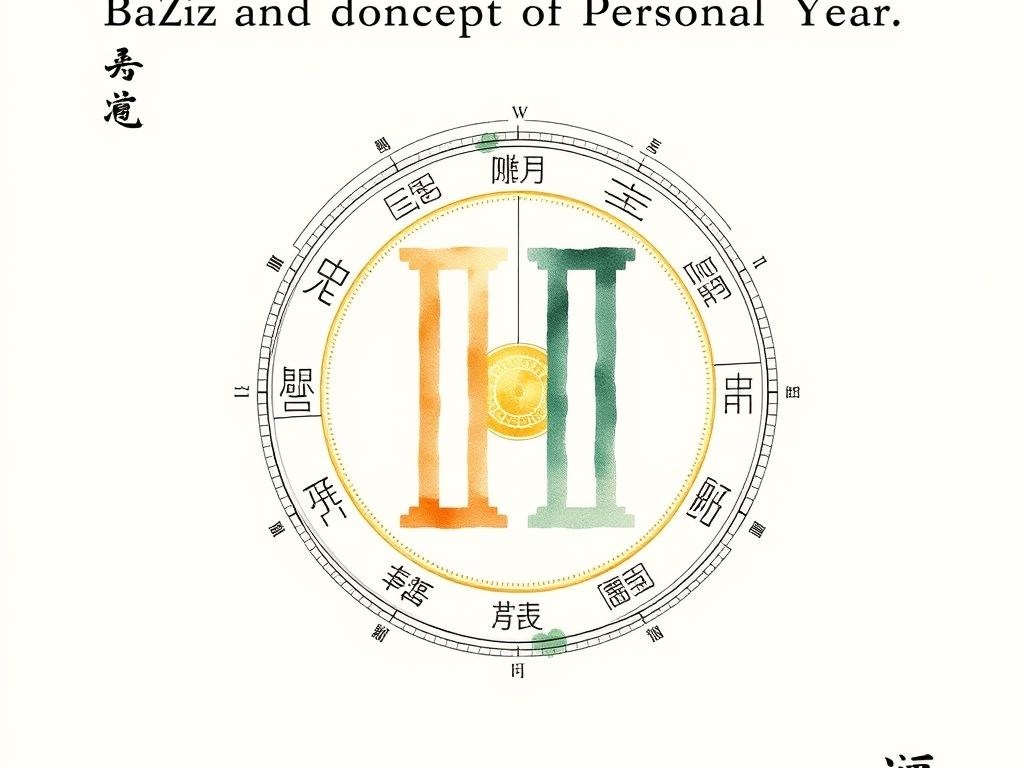
A personal year is the quiet frame behind most BaZi conversations about timing. When people say that a year felt fast, heavy, or strangely still, they are describing something the chart can help organize: the annual shift in emphasis that comes from the year pillar passing through the other pillars. The idea is not that the calendar hands you a script. It is that each year changes which parts of your chart get attention, the way a change of season changes which clothes you reach for. If you are new to the framework, start with BaZi for Beginners: A Step-by-Step Start.
This article explains what a personal year is, how it differs from a luck cycle, and how to use the concept without letting it harden into prediction. The goal is a vocabulary for noticing change, not a fortune-telling shortcut.
What the Year Pillar Actually Adds
Every year has a heavenly stem and an earthly branch, and in BaZi those two characters enter into dialogue with the pillars of your birth chart. The year stem carries an element, and the year branch carries another element plus hidden stems. When the year's energy meets your day master and the rest of your chart, it highlights certain dynamics: a year whose element feeds your day master can feel supportive, while a year whose element clashes with a branch you rely on can feel edgy.
The personal year is not a separate chart. It is your existing chart read through the lens of the current year. That is why two people born on different days experience the same calendar year differently, and why the same person experiences two years that look similar on paper in very different ways. For the mechanics of reading a year, see BaZi and Timing: Why Some Years Matter More.
Personal Year vs Luck Cycle
The personal year and the ten-year luck pillar are often confused, but they answer different questions. The luck pillar describes the climate of a longer period of life, usually ten years at a time, and it changes slowly. The personal year describes the weather inside that climate, a shorter pulse that changes every solar year. A supportive luck cycle can still contain difficult years, and a demanding luck cycle can contain a year of real relief.
Think of the luck pillar as the road and the personal year as the season on that road. Planning benefits from knowing both. If you are trying to schedule a major change, the year matters for timing and the luck pillar matters for context. For the longer view, read How to Read Your Luck Cycle Years and What Luck Pillars Mean in a BaZi Chart.
A Practical Way to Read Your Year
You can build a personal year reading in about twenty minutes. Write down your day master, note which element the current year stem brings, and check how that element relates to your day master and to the seasons already in your chart. Then ask three questions: does this year's element support, drain, or challenge your day master; does the year branch meet a branch in your chart in a combining, clashing, or neutral way; and where does your chart already have strength or scarcity in this element.
- Name the year stem element and the year branch element.
- State how each relates to your day master: support, output, wealth, authority, or companion.
- Check whether the year branch forms a clash or combination with a birth branch.
- Note one area of life where the chart already shows strength in that element.
- Choose one practical experiment for the year and set a review date.
The checklist keeps the reading observational. You are naming conditions, then testing them against real life, not collecting verdicts. If you do not know your day master yet, generate your chart with the BaZi calculator and read Understanding Your Day Master Element.
What a Personal Year Is Not
A personal year is not a promise that something specific will happen. The chart can describe pressure, support, and timing windows, but it does not contain the event itself. A year described as demanding can be handled well with preparation, and a year described as easy can be wasted by drift. The concept works best as a planning tool: it tells you what kind of season you are entering, and you decide what to plant.
It is also not a reason to freeze. Some people treat a difficult year as a signal to stop everything, which usually costs more than the chart ever suggested. The sober use is to adjust pace, expectations, and review dates, while keeping ordinary responsibility intact. For that framing, read Using BaZi for Life Planning Without Superstition.
Keeping the Concept Honest
The healthiest habit is to review your year notes twice: once at the start of the year and once at its end. The start is a forecast of conditions; the end is a record of what actually happened. Comparing the two tells you how the chart language maps onto your life, which is more valuable than any single prediction. Over a few years, the comparison becomes the practice, and the chart becomes a tool you have actually tested.
When the language stays humble, the personal year remains useful without becoming rigid. It is a way of asking what kind of season this is, and the answer always leaves room for you. For a wider view of how all the timing pieces fit together, see Understanding Your BaZi Season.
The Year as a Personal Experiment
You can treat any personal year as an experiment with three parts: a forecast, a plan, and a review. The forecast is the reading you write at the start; the plan is the adjustment you choose, such as protecting more review time or starting one project earlier; the review is the comparison you make at the year's end. Kept small, the experiment produces evidence about how the chart language works for you, and that evidence is more durable than any single insight. For the record keeping that supports the experiment, read How to Track Recurring Patterns in Your Life.
A year that is observed this way teaches you even when the forecast misses, because a miss is also data about the method, and data about the method is what turns a borrowed vocabulary into your own.
FAQ
Is the personal year the same for everyone born the same day?
No. The year meets each person's chart differently, and your day master and branches decide how the same year feels.
How long does a personal year last?
It follows the solar year and shifts at the new year's solar term, so the dates differ slightly from January 1.
Can a personal year predict money or love?
No. It describes emphasis and timing conditions, not events, and real choices still shape the outcome.
Do I need a reader to find my personal year?
No. With your chart and a calculator you can note the year stem and branch yourself, which is enough to start observing.