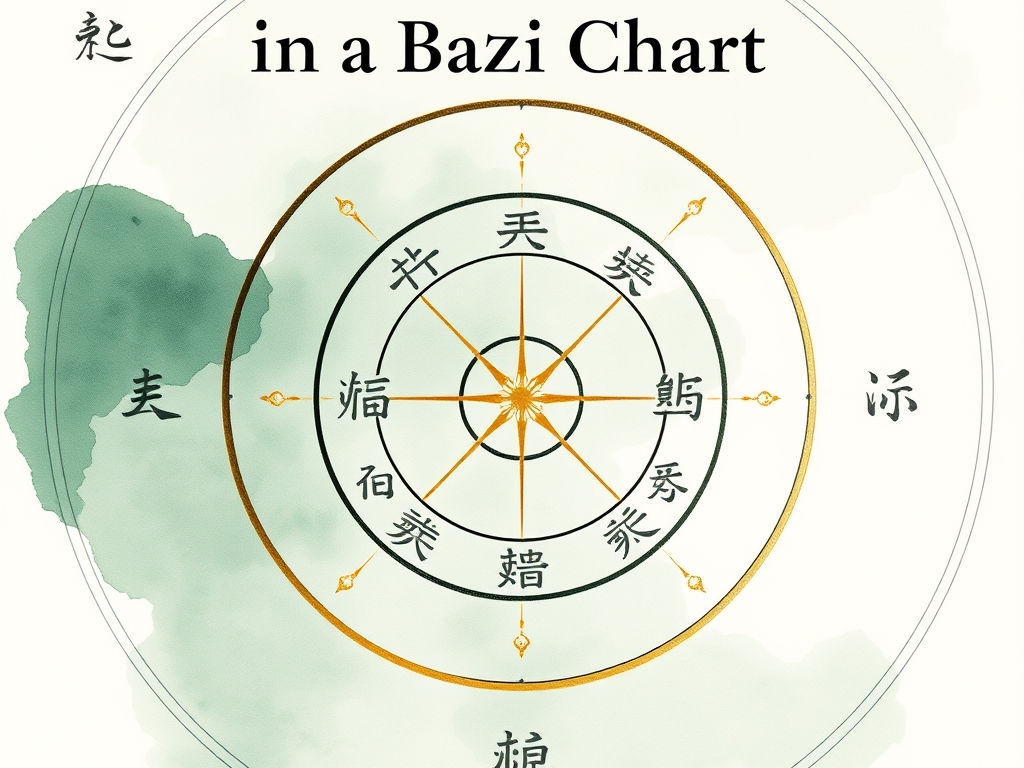
The Day Master is the Heavenly Stem of the Day Pillar in a BaZi chart, and it is the single most important reference point in classical Chinese reading. Every other symbol in the chart, from the Ten Gods to the seasonal strength, is interpreted in relation to it. Beginners often ask which element they are, and the honest answer is that the Day Master is a lens rather than a verdict: it describes tendencies, pressures, and preferences that you can compare with real experience.
Understanding the Day Master changes how you read a chart. Instead of memorizing long lists of symbols, you learn to ask what each element is doing for the central character of the chart. That shift, from collecting labels to following relationships, is what separates useful study from confusion.
What the Day Master Represents
In most schools of BaZi, the Day Master is described as the self. It is the element through which strengths, weaknesses, and habits are seen, much like a home address tells you which neighborhood the rest of the map belongs to. The element itself has a character: Wood is associated with growth and initiative, Fire with expression and visibility, Earth with stability and support, Metal with precision and boundaries, and Water with reflection and flow.
These descriptions are starting points, not personality profiles. Two people with the same Day Master can express it very differently depending on the season, the surrounding stems and branches, and the current luck cycle. That is why a responsible reading always looks at the full structure rather than a single symbol.
If you are new to the framework, start with What Is BaZi? and the overview at the BaZi section before diving into elements.
Why the Day Master Anchors the Chart
The Day Master matters because it gives every other symbol a direction. Without a reference point, a chart is just a collection of elements. With the Day Master in place, each element becomes something that supports, drains, controls, or is controlled by the self. The Ten Gods, for example, are simply names for those relationships: Resource supports you, Output expresses you, Wealth is what you manage, and Authority is the structure around you.
This relational view also explains why two charts with similar pillars can be read differently. The same element may be supportive in one chart and burdensome in another because the Day Master changes the center of gravity. Practical readers therefore begin every session by confirming the Day Master, its element, and its strength in the season before saying anything else.
How to Observe Your Day Master in Daily Life
Once you know your Day Master element, treat it as a hypothesis to test rather than a label to accept. Keep a simple week-long observation: note how you respond to pressure, to planning, and to change, and compare those responses with the common descriptions of your element.
- If your Day Master is Wood, test whether you feel energized by starting new things and frustrated by delay.
- If it is Fire, test whether visibility and expression restore your energy.
- If it is Earth, test whether stability, routine, and support feel grounding.
- If it is Metal, test whether precision, editing, and clear boundaries clarify your thinking.
- If it is Water, test whether reflection, rest, and quiet time restore you.
Write down what matches and what does not. The mismatches are often more informative than the matches, because they point to the parts of the chart, such as season or luck cycle, that change how the Day Master behaves.
A Practical Week-Long Exercise
To make the Day Master concrete, run a one-week observation with a small notebook. Each evening, write one sentence about the kind of day you had, one sentence about what drained you, and one sentence about what restored you. Do not try to force the answers to fit your element; record them honestly.
At the end of the week, look for patterns. If your element is Fire and you notice that presentation days energize you while solitary administrative days exhaust you, that supports the Fire description. If the opposite is true, the mismatch is useful information: it may mean the season, the current luck cycle, or another pillar is changing how your element expresses itself. The point of the exercise is not to prove the chart right, but to build a personal record you can compare with future readings. Over a few months, this record becomes far more reliable than any single interpretation.
Common Mistakes Beginners Make
The most common mistake is treating the Day Master as a fortune or a fixed personality type. The Day Master does not predict events, and it does not mean you are stuck with one style of behavior. It describes a baseline tendency that interacts with everything else.
A second mistake is ignoring the season. A Wood Day Master born in spring behaves differently from a Wood Day Master born in autumn, because seasonal strength changes how much support the element receives. Comparing charts without the season is like reading a map without knowing which way is north.
A third mistake is assuming the Day Master is the same as the zodiac sign. The zodiac sign comes from the Year Branch, while the Day Master is the stem of the Day Pillar. They answer different questions, and confusing them produces shallow readings. You can generate your chart and see the difference directly with the BaZi calculator.
How the Day Master Fits Into a Full Reading
The Day Master is the starting point, not the whole story. A complete reading combines the Day Master with the seasonal strength, the Ten Gods, the hidden stems, and the current luck cycle. Each layer qualifies the others. A strong Day Master can carry responsibility but may need output and control to stay balanced; a weaker one may thrive with resource support and good timing.
This is why the same element can appear as opportunity in one chart and pressure in another. The practical skill is learning to read the relationships rather than memorizing keywords. For more on the structure behind these layers, see How a BaZi Chart Works and browse the BaZi article library.
FAQ
Is the Day Master the most important part of my chart?
It is the anchor for interpretation, but it only makes sense together with the rest of the pillars and the season.
Can I change my Day Master?
No, and you do not need to. The value is in understanding how your tendencies interact with circumstances.
How do I find my Day Master element?
Run your birth data through the BaZi calculator and read the Day Pillar stem in the result.
Does the Day Master predict my future?
No. It describes tendencies and timing patterns you can examine alongside real evidence and your own judgment.