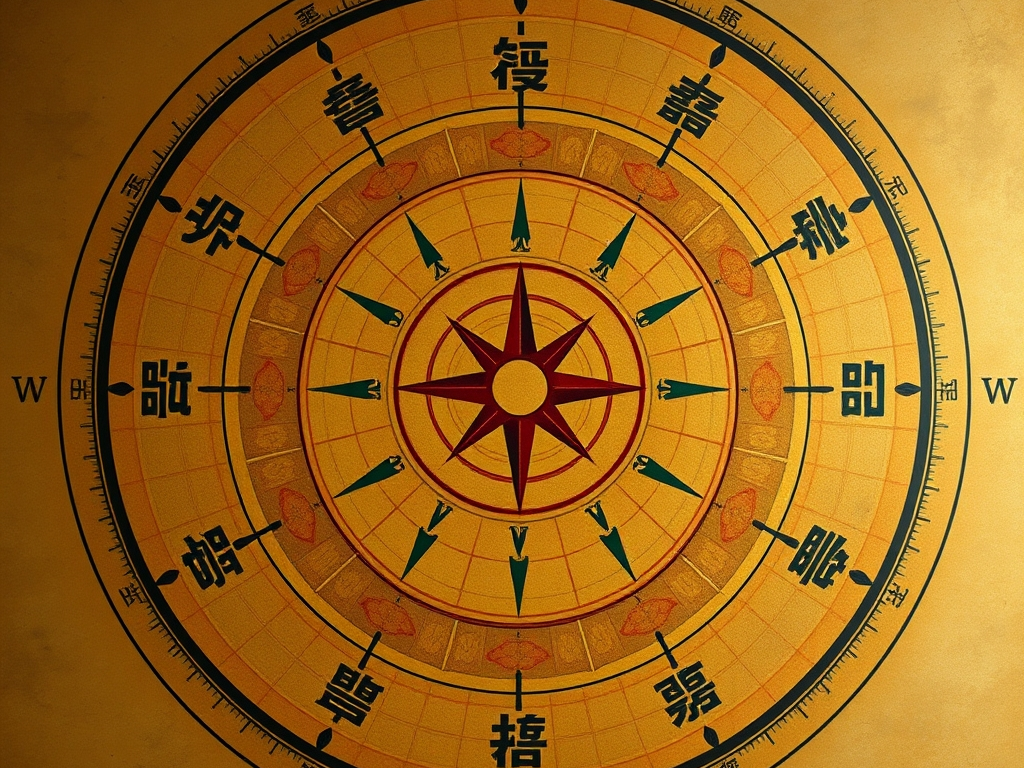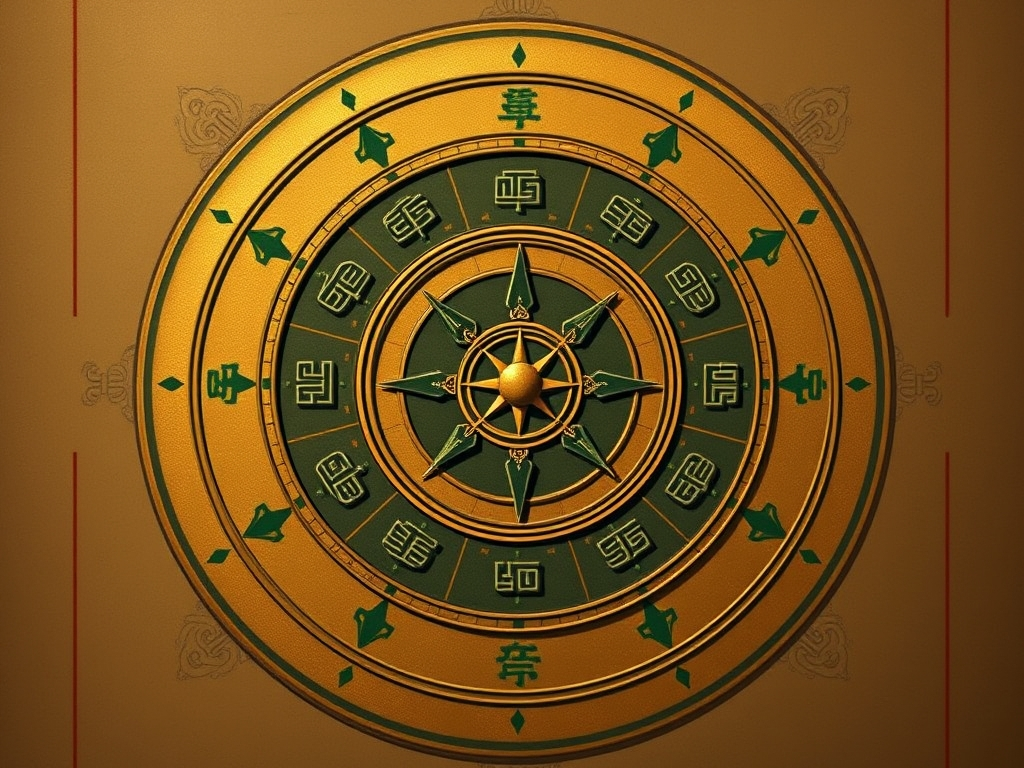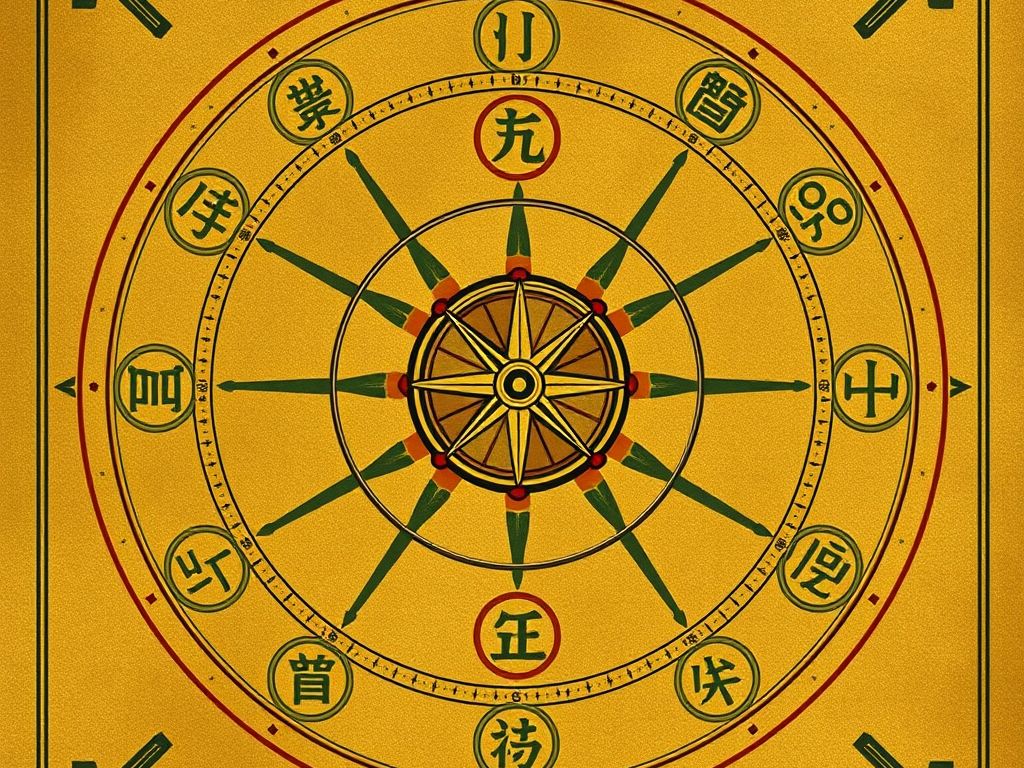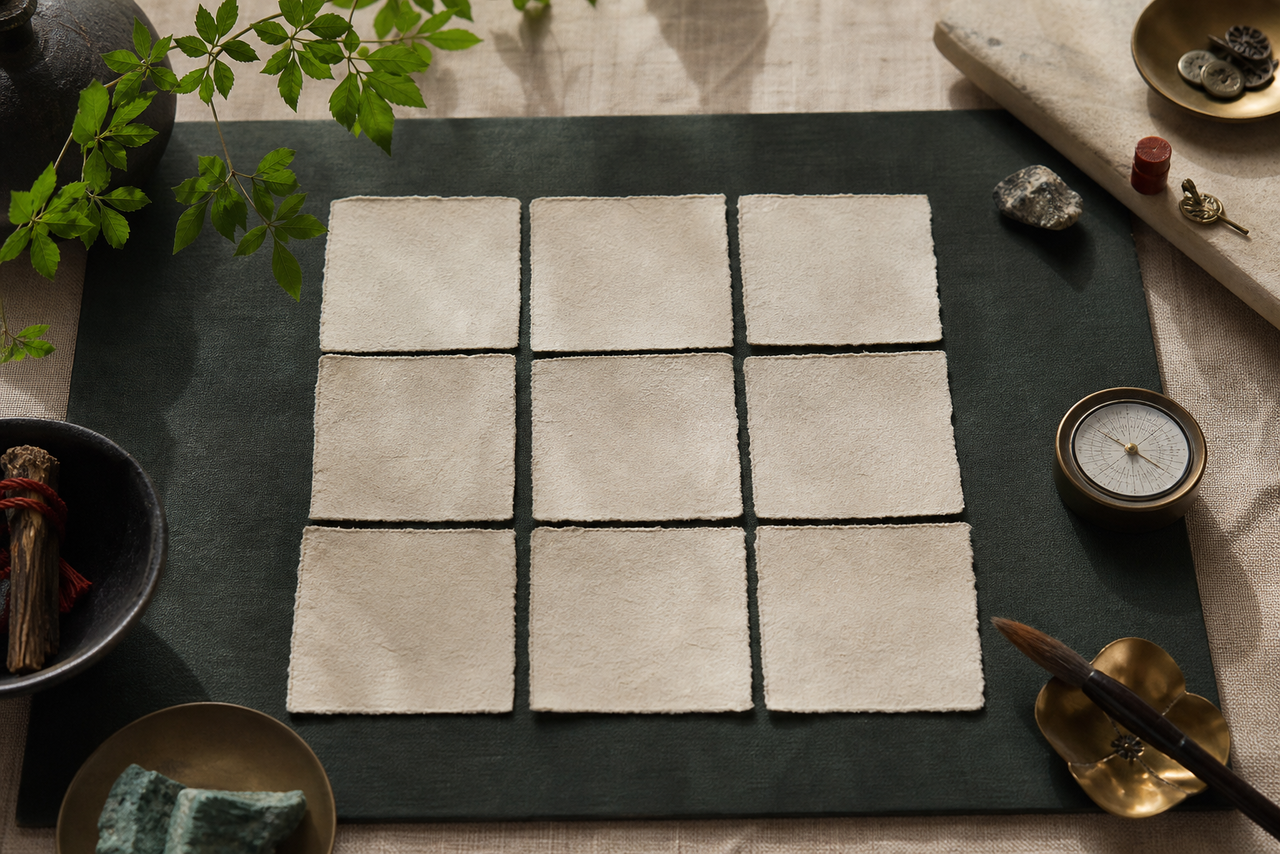
The Nine Palaces are the spatial framework of a Qimen Dunjia chart. They appear as a three-by-three grid: eight outer palaces associated with directions and one palace in the center. Each palace holds several symbolic layers and helps a reader compare positions, people, options, and relationships. A palace is a container for interpretation, not a permanent verdict about whether something is lucky or unlucky.
The Three-by-Three Framework
Picture a square divided into nine equal spaces. The middle space is the center palace. Around it sit eight palaces corresponding to north, northeast, east, southeast, south, southwest, west, and northwest. This layout gives the chart a stable geography even while the symbols placed within it change according to time.
The grid is sometimes confusing to U.S. beginners because a traditional chart may orient south at the top rather than north at the top, as on a modern map. Before reading any symbol, check the orientation used by the chart software, teacher, or book. A mistaken assumption about the top of the page can reverse the directions and undermine the entire analysis.
The palace framework lets Qimen express both location and relationship. A factor is not merely listed; it is placed somewhere. That position connects it with a direction, surrounding symbols, and other palaces. The grid therefore supports questions about movement, interaction, alignment, distance, and strategic position.
What a Palace Contains
A palace can hold a Door, a Star, a Deity, Heavenly Stems, and other technical markers used by a particular school. These layers describe different aspects of the situation. The palace brings them together so they can be read as a combination.
Think of a palace as a room during a meeting. The room has a location and general conditions, but what happens also depends on who is present, what they are trying to do, how they communicate, and what resources they have. Calling the room "good" or "bad" without considering its occupants would be too crude. In the same way, a palace name or direction alone does not decide the outcome.
Some teaching materials attach lists of themes to each palace. Such lists can help memory, but they should not be treated as universal predictions. A direction may carry broad associations within the traditional system, yet the current Door, Star, Deity, stems, question, and reading method determine how those associations become relevant. Keywords are a vocabulary aid, not a complete interpretation.
The Center Palace
The center occupies a special position because it has no outward compass direction of its own. It links the grid and can represent central conditions, consolidation, or a factor that is not expressed through one outer direction. The exact handling of center-palace symbols can vary by chart method and school, which is why beginners may encounter different instructions for how certain layers are placed or interpreted.
Do not resolve this variation by silently combining rules from unrelated sources. Choose one coherent method, note how it treats the center, and apply it consistently while learning. Later, you can compare systems with enough context to understand why they differ.
The center is also a useful reminder that not every question is answered by physical movement. Sometimes the key issue is internal coordination, the overall environment, or a condition affecting all options. A responsible interpretation stays open to that possibility instead of forcing every center placement into a compass direction.
Directions and Scale
The eight outer palaces connect chart symbols with directions, but direction has to be interpreted at the scale of the question. For a trip, it might refer to the destination relative to the starting place. For an office decision, it might describe where a person or room is located. In a symbolic comparison, a directional palace may stand for an option even when no travel occurs.
Scale prevents absurd conclusions. Northeast across a building, northeast across a city, and northeast across a continent are not interchangeable actions. If a reader suggests movement, define the starting point, distance, purpose, timing, and practical cost. Safety, accessibility, weather, law, and common sense remain more important than performing a direction mechanically.
Remote work also complicates literal direction. An online meeting involves people in several locations, devices, networks, and no single shared movement. Some practitioners use the user's physical location; others focus on timing or represent the parties symbolically. The key is to state the chosen convention rather than presenting one modern adaptation as an ancient universal rule.
Relationships Among Palaces
A Qimen reading often becomes meaningful when two or more palaces are compared. One may represent the person asking, another the goal, and another a competing option or other party. Their relative conditions and traditional relationships can suggest ease, support, demand, friction, or imbalance.
This does not reduce to "strong beats weak." A demanding option may still be appropriate if it matches the purpose and the person has adequate resources. An apparently supportive option may be easy but fail to address the real goal. Relationship language should become practical questions: Who has leverage? Where is cooperation available? Which path requires more preparation? What risk can be reduced?
Palaces can also show that two observations are simultaneously true. A plan may have good access but poor endurance. A conversation may have strong intent but weak clarity. The grid holds these tensions without requiring the reader to collapse them into one cheerful or alarming label.
Example: Choosing a Meeting Format
Suppose Elena must discuss a delayed project with a partner. She can meet in person at the partner's office, schedule a video call, or send a detailed written update. She knows the delay's causes, the contractual deadline, and the partner's availability. Those facts establish the real decision.
In a hypothetical chart, the palace representing an in-person meeting contains a combination associated with direct engagement but considerable effort. The palace used for remote communication suggests convenience and speed but a greater chance of fragmented attention. Elena's own palace appears capable of preparation yet pressured by time.
The chart does not declare one palace universally favorable. Instead, it helps Elena design the action. She may choose the video call because travel would consume the only remaining preparation time, then reduce the attention risk by sending an agenda and limiting the call to three decisions. If trust is already strained and nonverbal communication matters, she may decide that the effort of meeting in person is justified. Either choice remains grounded in the relationship, contract, schedule, and purpose.
Common Palace Misunderstandings
The first misunderstanding is treating a direction as a guaranteed destination for success. A palace describes symbolic conditions; it does not remove traffic, cost, health limitations, or the need for consent. The second is reading one fixed keyword for every chart. Palaces gain specific meaning from their contents and the question.
The third is assuming that a symbol physically located in one box can never relate to another. Qimen interpretation frequently considers interactions across the grid. The fourth is mixing chart orientations. Always label the directions before interpreting. Finally, do not assume that the center is simply empty or irrelevant. Its role may be important even when it is handled differently from the outer eight.
FAQ
Are the Nine Palaces the same in every chart?
The three-by-three framework and directional positions are stable, but many symbolic layers placed within the palaces change with the chart time. The arrangement you interpret therefore belongs to that specific chart.
Does each palace have one fixed meaning?
No. Palaces have traditional associations, but their practical meaning depends on the question, the symbols they contain, their relationships, and the method being used. Fixed keyword lists are introductory aids only.
Is a negative symbol worse in every palace?
No. Symbolic names are not literal verdicts, and context can change their relevance. A quality that complicates one objective may be useful for another. Interpret the combination and then compare it with actual risks.
Must I physically face a palace's direction?
Not automatically. Some practices involve facing or moving, while many readings use palaces to represent options or actors. Define the purpose and follow safety and practical constraints before considering any directional action.
Where to Go Next
Once the grid is clear, learn what fills it in Understanding the Doors, Stars, and Deities. For a review of the complete reading sequence, see How a Qimen Dunjia Chart Works. You can browse more lessons in the Qimen Dunjia article collection. When practicing, label every direction, identify the question's scale, and describe each relevant palace before assigning any judgment.