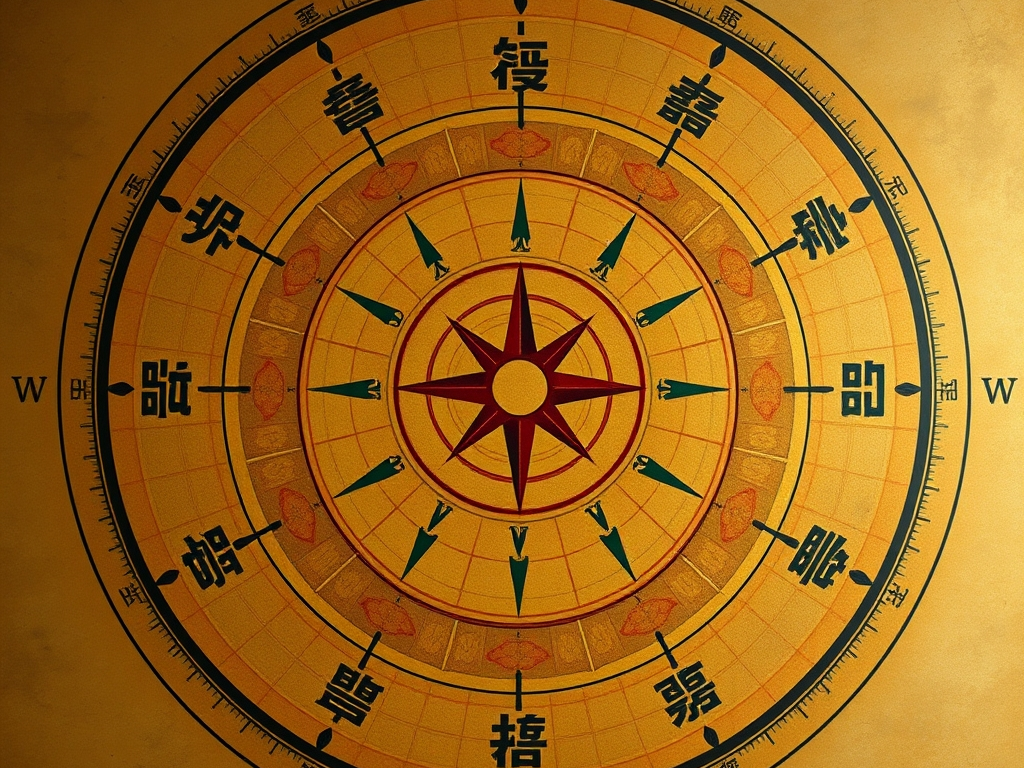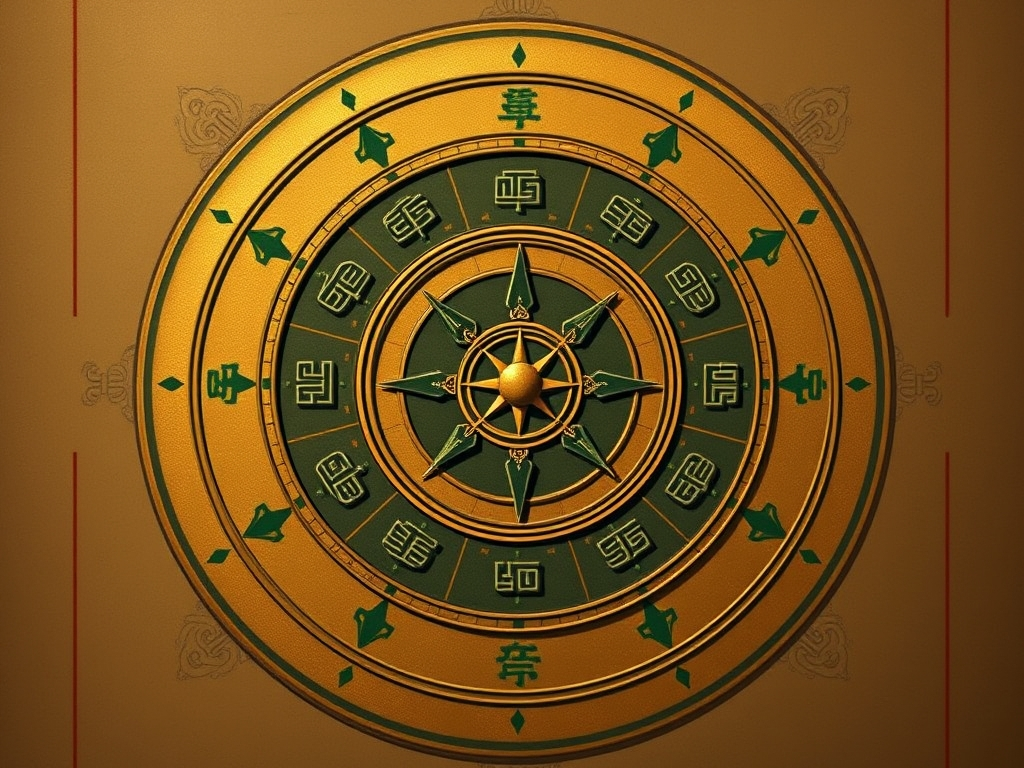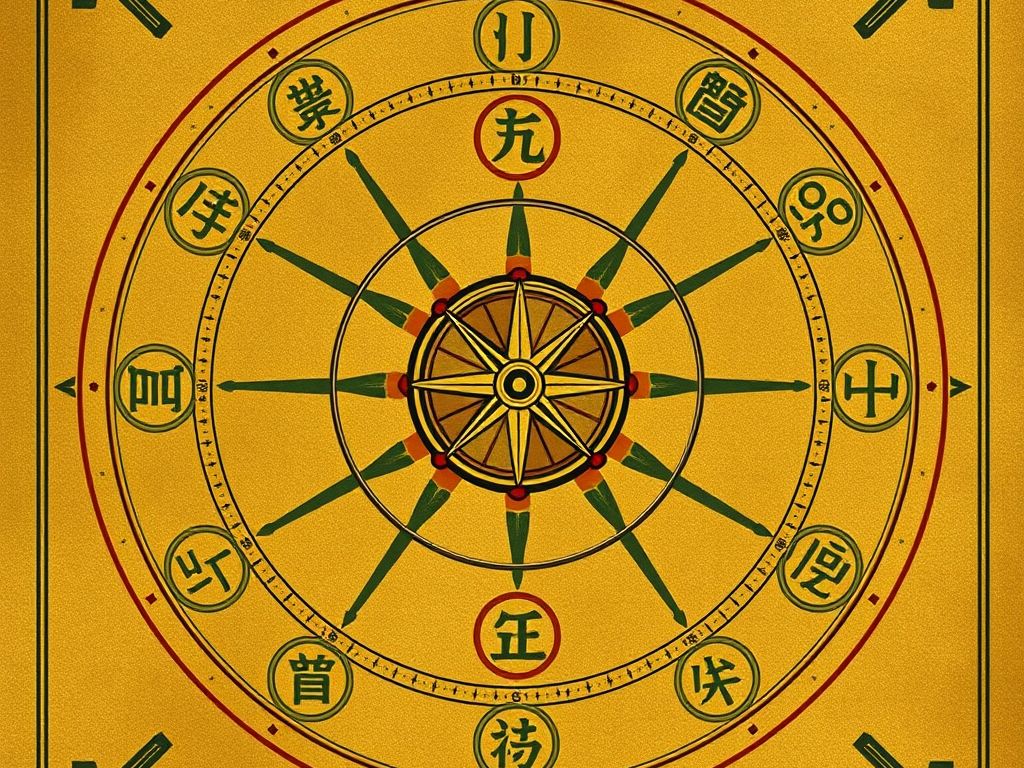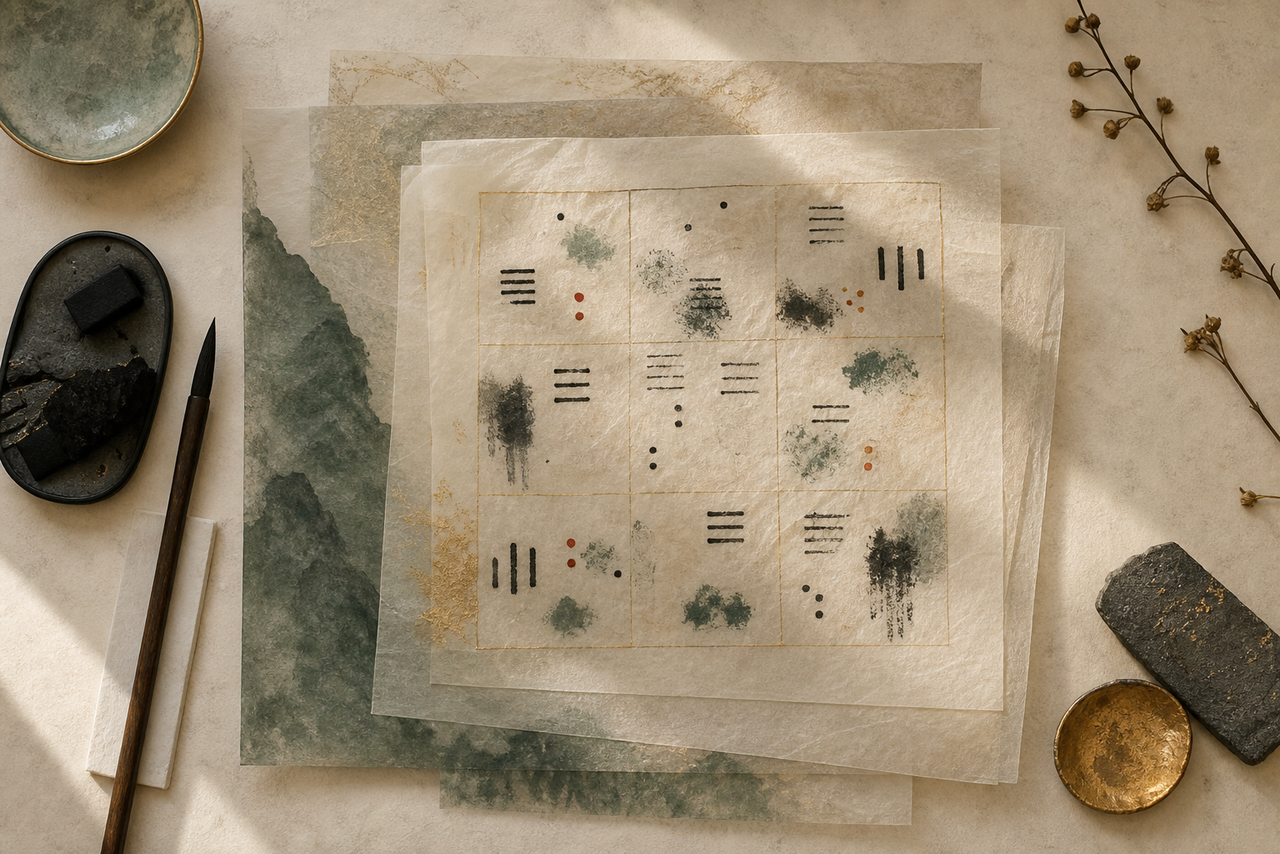
A Qimen Dunjia chart works by placing several sets of traditional symbols into a three-by-three grid for a particular moment. The reader connects the question with relevant positions in the chart, studies how the symbolic layers interact, and compares that picture with the real situation. It is not a row of independent fortune-cookie messages. It is a time-specific map whose meaning comes from relationships, context, and a defined purpose.
A Chart Belongs to a Moment
The first principle is simple: every Qimen chart has a date and time. The calculation converts that moment into a structured arrangement using the traditional Chinese calendrical system. Because the arrangement changes with time, a chart made for Monday morning is not automatically the chart for Friday afternoon.
This matters because a Qimen question usually concerns action under particular conditions. "Should I contact the client?" is too loose if it does not identify the decision window and what "contact" means. A better formulation might be, "What should I consider if I send the revised proposal during tomorrow's business hours?" The clearer question provides a scale for interpreting the chart. It also prevents a reader from stretching a symbol to cover every possible future.
The chart time is not necessarily a claim that the moment mechanically causes events. Within practice, schools may choose a time according to different rules, such as when a question is asked or when an action is planned. For beginners, consistency is more important than pretending that these methodological differences do not exist. Record which time you used and why.
The Nine Palaces Form the Map
The visible framework is the Nine Palaces, a three-by-three grid with eight outer positions and a center. The outer palaces correspond to directions. A palace is best understood as a location or container in which multiple chart factors gather. It is not a box with one permanent meaning.
Depending on the reading method, a palace may represent the person asking, another party, an action, a goal, or an aspect of the environment. A reader identifies the relevant position according to the question and the rules being used. Then the reader looks at what occupies that palace and how it relates to other important palaces.
Relationship is crucial. Two options may appear in different palaces, allowing a comparison of support, access, pressure, or compatibility. One palace may look strong in isolation but have a difficult relationship with the palace representing the person. Another may seem modest yet offer a more workable connection. The grid turns interpretation into a comparison rather than a hunt for one lucky label.
The Symbolic Layers
Several layers are arranged in or associated with the palaces. The Heavenly Stems are traditional calendar symbols that can represent actors, conditions, or relationships. The Doors describe types of activity and access, such as opening, resting, producing, or encountering obstruction. The Stars add qualities related to capacity, expression, or the character of circumstances. The Deities indicate another level of tone, influence, or strategic atmosphere.
These brief definitions are starting points, not universal equations. A Door is not read without its palace and companions. A Star does not have exactly the same effect in every question. A Deity's dramatic English name should not be interpreted as a literal being arriving to control the outcome. Each layer modifies the others, just as the words in a sentence change meaning through grammar and context.
Other technical factors may be included in a full reading, such as cycles, formations, combinations, or the relative condition of a palace. Different schools prioritize these details differently. Beginners do not need to flatten those differences into one supposed master rule. They need a transparent method: identify the question, locate the relevant symbols, read the layers together, and test the interpretation against known facts.
A Layered Reading Process
A practical reading can follow a repeatable sequence. First, state the decision in one sentence and specify the time horizon. Second, identify the palace or marker associated with the person asking. Third, identify the palace or marker related to the option, goal, or other party. Fourth, describe each relevant palace without deciding whether it is simply "good" or "bad." Fifth, compare their relationship and convert the symbolic observations into practical questions.
Suppose a palace suggests easy communication but low endurance. That combination might prompt questions such as: Is this better for an introduction than a long negotiation? Is the message clear enough to make brief access useful? If another palace suggests slower movement with stronger preparation, the reader can compare speed against resilience. The value comes from the contrast.
Finally, apply a reality check. Does the interpretation fit the known situation? What evidence supports it? What information is missing? What action remains safe, legal, ethical, and feasible? A chart interpretation that requires ignoring obvious facts is not improved by using more technical vocabulary.
Example: Comparing Two Courses of Action
Consider Jordan, who has finished a proposal and has two possible approaches. Option A is to send it immediately by email. Option B is to request a short call first, clarify the client's priorities, and send a revised version afterward. Jordan knows the deadline, budget range, and client's stated requirements. The chart is used to examine strategy, not to invent those facts.
In a hypothetical reading, the palace associated with Option A contains symbols suggesting direct access and quick movement, but it also shows tension around clarity. The palace associated with Option B suggests slower progress, stronger cooperation, and more effort. Jordan should not conclude that A will fail and B will succeed. Instead, the comparison identifies tradeoffs.
Jordan might improve Option A by adding a one-page summary and asking a precise follow-up question. Or Jordan might choose Option B if the schedule allows, because clarifying the client's priorities has ordinary business value. If the deadline is in two hours and no call is possible, the symbolic preference for discussion does not make an unavailable option feasible. The chart supports adaptation within constraints.
Notice that the result is a decision with reasons: time available, quality of information, communication risk, and the relative effort of each path. The reading contributes a structured lens, while Jordan remains responsible for the proposal and professional conduct.
Why Symbols Are Never Read Alone
Isolated-symbol reading fails for three reasons. First, translations compress broad concepts into short labels. Second, the same symbol can serve different functions in different questions. Third, surrounding layers can strengthen, redirect, or complicate its expression. A symbol associated with openness may help a request for a conversation but be less relevant to a task requiring confidentiality. A symbol associated with rest may support recovery or patient planning yet frustrate an urgent launch.
Context also includes the reader. If you fear one negative-sounding label, you may selectively notice evidence that confirms the fear. If you want a particular answer, you may overvalue pleasant symbols. Writing down the reading before the outcome and naming at least one alternative interpretation helps reduce this bias.
FAQ
Does a Qimen chart show one fixed future?
No. It presents a symbolic configuration for a selected moment and question. Choices, new information, other people, and changing conditions still matter. Responsible readings use conditional language and consider more than one scenario.
Why do two readers interpret the same chart differently?
They may use different schools, select different focal markers, emphasize different layers, or understand the question differently. A good reader should be able to explain the method and connect the interpretation to the actual decision.
Can beginners read only the Doors?
The Doors are a useful entry point, but reading them alone removes the palace, timing, Stars, Deities, stems, and relationships that shape meaning. Use a simplified learning exercise if needed, while clearly recognizing that it is not a complete reading.
Should I cast several charts for the same question?
Usually not. Repeated checking can turn uncertainty into a search for the answer you prefer. Use one clearly timed chart, record the interpretation, gather real information, and revisit only when the situation or decision genuinely changes.
Where to Go Next
To deepen your understanding of the grid that holds these layers, continue with The Nine Palaces in Qimen Dunjia Explained. The Doors, Stars, and Deities guide examines the three major layers in more detail. For the broader context, return to the Qimen Dunjia overview. Practice with small, reversible decisions, and keep your chart notes beside the factual reasons for each choice.