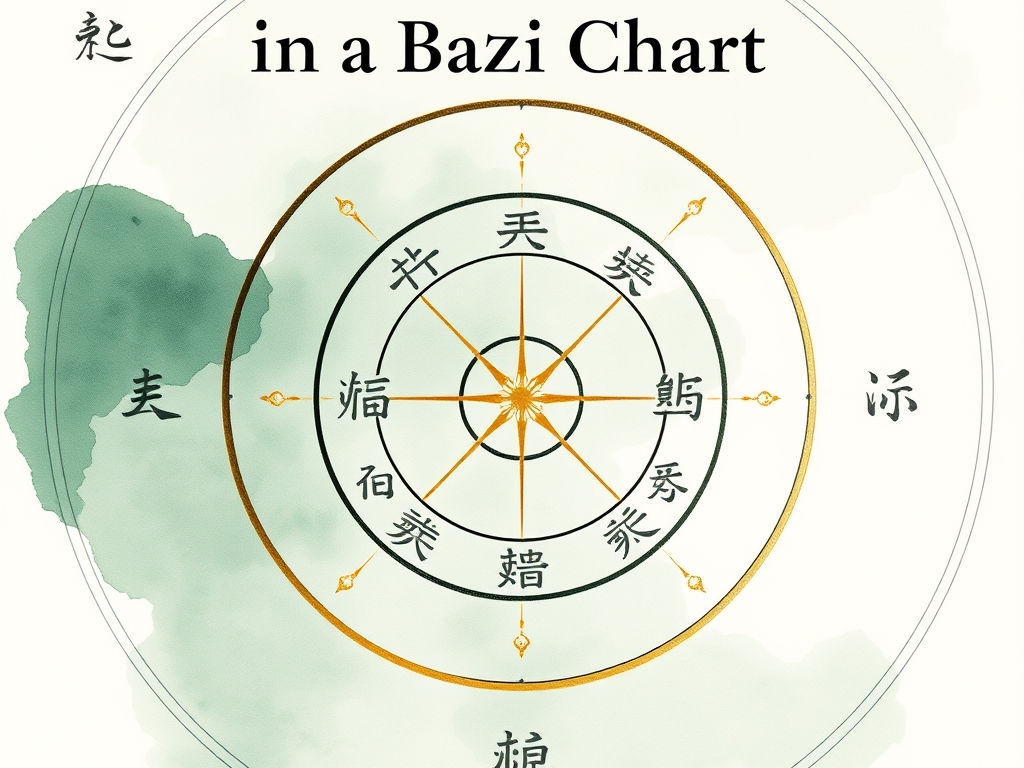
The twelve earthly branches are the backbone of the Chinese calendar and of BaZi. Every pillar is a pair of a heavenly stem and an earthly branch, and while the stem often gets the attention, the branch does most of the work. Branches carry season, direction, and hidden stems, and they are where the calendar's rhythm actually lives. This article explains how BaZi uses branches, why they matter more than they look, and how to read them in a chart, starting from the general map in Understanding the Twelve Earthly Branches.
What a Branch Is
An earthly branch is one of twelve characters that mark the months of the year, the hours of the day, and the years of a twelve-year cycle. Each branch has a season, a direction, an element, and a set of hidden stems. The branch is the container: it tells you where the energy is and what season it belongs to, while the heavenly stem on top tells you how that energy is expressed. The pair works like a label and a box, and in BaZi the box often carries more information than the label.
The twelve branches are the same ones used in the zodiac, which is why each year has an animal. But in BaZi, the branch's seasonal and elemental content matters more than the animal symbol. A beginner who sees only the animal is looking at the surface of the system. The deeper structure is described in How to Read Heavenly Stems and Earthly Branches.
Branches as Seasons
Each branch belongs to a month of the solar calendar and therefore to a season. The Tiger, Rabbit, and Dragon branches rule spring; Snake, Horse, and Goat rule summer; Monkey, Rooster, and Dog rule autumn; and Pig, Rat, and Ox rule winter. The seasonal content is what makes the month pillar so strong in a chart, because the month branch always carries the full seasonal energy of its time of year.
Branches also carry direction: the same seasonal sets map to east, south, west, and north, with Earth in the transitions. Direction matters in Feng Shui and in some Qimen readings, and it gives the branches a spatial meaning alongside their temporal one. For the directional side of the same symbols, see Direction and Movement in Qimen.
Hidden Stems Inside Branches
One of the most important ideas in BaZi is that each branch contains hidden stems. A branch is not a single element; it is a small bundle of stems, with one main stem and one or two secondary ones. The Rabbit branch, for example, contains a main Wood stem and a secondary Water stem. These hidden stems explain why a chart can appear to be missing an element when that element is actually present inside a branch.
Reading hidden stems changes how you count elements and how you interpret the chart. When a beginner counts the eight visible characters and finds no Metal, a careful reader checks the branches for Metal hidden inside them. The full mechanics of this layer are explained in The Hidden Stems in a BaZi Chart, and they are essential for understanding why two superficially similar charts can read very differently.
Reading Branches: A Checklist
When you read the branches of a chart, work through this checklist:
- List the four branches of the chart and the element of each one.
- Note the season of each branch, starting with the month branch.
- Identify the hidden stems of each branch and the main stem of each.
- Compare the branch elements with the day master to see which relationships appear.
- Check the combinations and clashes between branches, since neighboring branches interact.
- Write a one-sentence summary of what the branches emphasize overall.
Branch combinations and clashes are a whole layer of their own, but the checklist gives you a starting point without overwhelming you. The most useful habit is describing the branches in plain language before trying to interpret them, because a clear description prevents symbolic guesswork. For more on the twelve branches as a cycle, read Understanding the Twelve Earthly Branches.
Common Misconceptions About Branches
The first misconception is that the zodiac animal is the meaning of the branch. The animal is a memory device; the branch's real content is its season, element, direction, and hidden stems. The second misconception is that the stem matters more than the branch. In many readings the branch carries more weight, because it stores the seasonal energy and the hidden stems that the stem cannot show.
The third misconception is that branches work alone. Branches interact with each other through combinations and clashes, and they are always read in the context of the whole chart. A branch that looks strong in isolation may be modified by a neighboring branch, which is why chart reading is a holistic skill. For a structured introduction to the whole chart, read How a BaZi Chart Works.
Branches Beyond BaZi
The twelve branches are not exclusive to BaZi. They anchor the Chinese calendar, appear in Feng Shui as directional markers, and provide the hourly structure used in daily timing practices. Learning the branches once gives you a key that opens several systems, which is one reason they reward careful study. The calendar connection is explored in Using Traditional Calendars in Modern Life, and the monthly rhythm in How the Lunar Calendar Shapes a Week.
A practical way to make the branches memorable is to walk the cycle in your own environment. Start with the current month, name its branch, and describe its season, element, and direction from memory; then move forward one month and repeat. After two or three months, the cycle stops being a list and becomes a map you can navigate. The same habit works with the hourly branches: noticing which two-hour block you are in and what quality it carries turns the system into a daily reference rather than a chart-reading chore.
FAQ
Are branches more important than stems?
Most readers treat branches as the heavier layer because they carry season and hidden stems, but both are read together.
Do I need to memorize the zodiac animals?
The animals help recall, but the branch's season, element, and hidden stems are what actually carry the reading.
Why do branches contain hidden stems?
Because a season develops in stages, and the branch stores the elements that appear across those stages.
Can branches change meaning in different charts?
Yes. A branch always keeps its own content, but combinations, clashes, and the chart context modify how it functions.