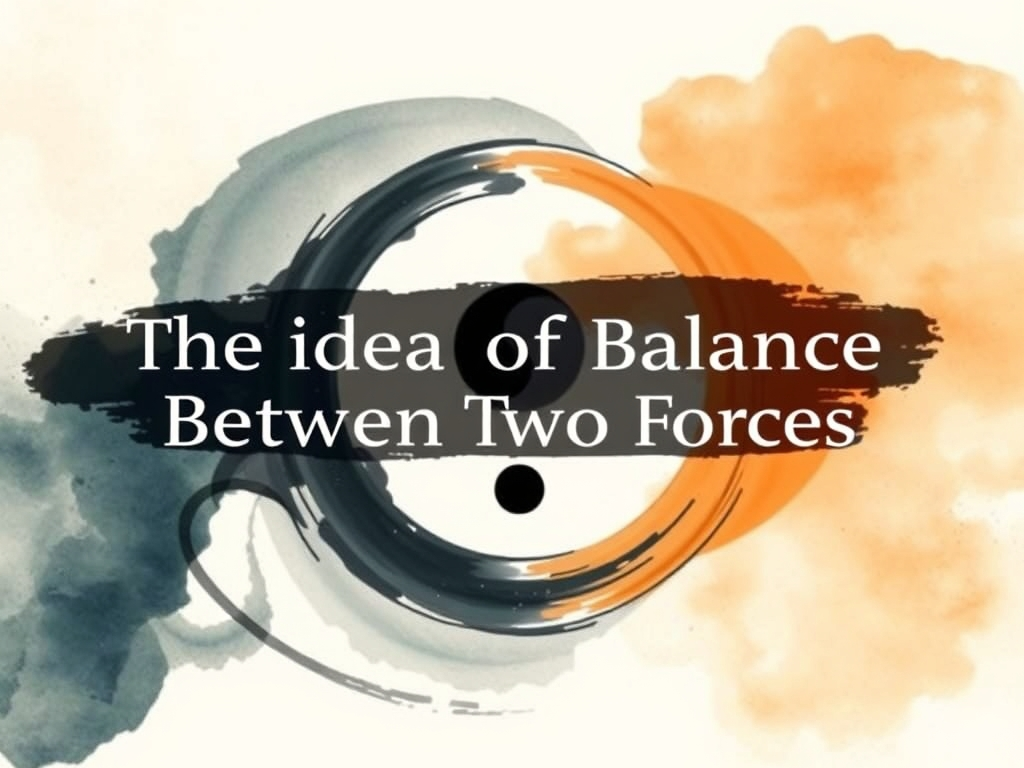
Balance is the most repeated word in Chinese metaphysics, and one of the least understood. It is not a still middle point where nothing happens; it is a working relationship between two forces that keep each other honest. Yin and yang are the famous pair, but the same logic runs through the five elements, the ten gods, and the interaction between structure and change. Understanding balance as a relationship rather than a position changes how you read every chart and every season. If you are new to the ideas, start with Five Elements Theory for Beginners.
This article explains what balance really means in the tradition, how to spot it in charts and daily life, and why chasing perfect balance is usually a mistake.
Balance as a Working Relationship
Two forces are in balance when each can do its job without the other becoming excessive. Day needs night to be day; movement needs rest to be movement; clarity needs depth to be clarity. The balance is not a fixed ratio but a rhythm, and the rhythm changes with the season, the hour, and the situation. What looks like imbalance on paper may be exactly right for the moment.
This is why a chart that looks uneven is not automatically flawed. The tradition reads imbalance in context: a chart heavy in one element may simply be living in a season that needs that element. For how the elements balance each other, read Five Elements Balance in a Birth Chart.
Yin and Yang as the Basic Pair
Yin and yang are not good and bad; they are complementary qualities that define each other. Yang is activity, clarity, warmth, movement; yin is receptivity, depth, coolness, stillness. Every moment contains both, and the practical skill is noticing which one the moment needs more of, then supplying it without losing the other.
- Work needs yang: clear action and visible effort.
- Rest needs yin: stillness and absorption.
- A conversation needs both: speaking and listening.
- A season needs both: growth and storage.
The list shows balance as a sequence, not a position. For how the pair appears in daily life, read How to Use the Five Elements in Daily Life.
The Dangers of Chasing Balance
The pursuit of perfect balance creates its own imbalance. Someone who constantly checks their chart for deficits can end up adding elements everywhere, and the result is a muddy picture instead of a balanced one. The tradition is more practical: balance is what allows the moment's work to happen, and sometimes that means letting one force lead.
For the difference between balance and perfection in the tradition, read Balance vs Perfection in Traditional Thought.
Signs a Pair Is Out of Balance
You can recognise imbalance by its symptoms before you ever look at a chart.
- Constant activity with no rest, or constant rest with no movement.
- Endless talk with no listening, or endless listening with no voice.
- All structure and no flexibility, or all flexibility and no structure.
- Over-planning every hour, or refusing to plan any.
Each symptom points to the missing side of a pair. For how to read such patterns in your own life, see How to Track Recurring Patterns in Your Life.
A Five-Step Balancing Practice
Use this short practice when a situation feels stuck in one force.
- Name the two forces at work in the situation.
- Name which one is leading right now.
- Name what the leading one is producing.
- Name the smallest addition of the other force.
- Apply it once, then observe for a day.
The practice is deliberately small, because balance is restored in steps, not overhauls. For how timing supports the same logic, read The Concept of Season in a Life.
Balance Is Not Neutrality
Balance should not be confused with neutrality. A balanced meal is not tasteless; a balanced argument is not weak; a balanced life is not flat. The goal is a relationship in which each force can appear fully when needed, which produces a dynamic, responsive life rather than a grey one.
For how the tradition describes the individual's place within these forces, read How Chinese Metaphysics Views the Individual.
The balance idea also applies to how you study the system itself. Too much theory without practice produces a head full of symbols and no sense of how they land in life; too much practice without theory produces observations that never connect. The tradition holds both in tension, and the student who studies it well holds them too: learn the structure, then test it in the week, then return to the structure with the test in hand. The alternation is the balance, and it keeps the study alive.
The same rhythm appears in any skill worth learning. A musician practises scales and pieces; a writer drafts and revises; a reader of charts studies the theory and then reads real charts. In every case, the two forces feed each other, and the practice that refuses one of them starves. Balance, in the end, is less a state to achieve than a rhythm to maintain, and the tradition's great contribution is to give that rhythm a name and a place in daily life.
Balance in a Chart, Not a Checklist
In a birth chart, balance is often mistaken for a count of elements. The tradition reads it differently: a chart is balanced when its elements can do their jobs, which depends on the season, the day master, and the question at hand. A chart with little wood may still function beautifully in a wood season; a chart heavy in metal may be exactly right for a year that demands decisions. Counting elements without context produces false alarms, and false alarms are the enemy of the practice.
The practical version is to ask what the moment needs rather than what the chart lacks. If a season demands action and the chart is naturally still, the answer is not to add action everywhere but to add it at the right moments. Balance is a timing skill as much as a composition skill, and the people who read it that way get more use from the system than those who treat it as arithmetic.
FAQ
Is balance the same as equality?
No. Balance is a working relationship that changes with context; sometimes the right balance is seventy-thirty for a season.
How do I know if my chart is balanced?
Read the chart in context, against the season and the question, rather than counting elements; a good reader reads imbalance as information, not defect.
Can I balance my life by adding elements?
Sometimes, but the better question is what the moment needs; adding the missing force at the right time matters more than adding it everywhere.
Is yin always calm and yang always active?
As a general description, yes, but each force contains shades of the other, and context decides which quality is needed.