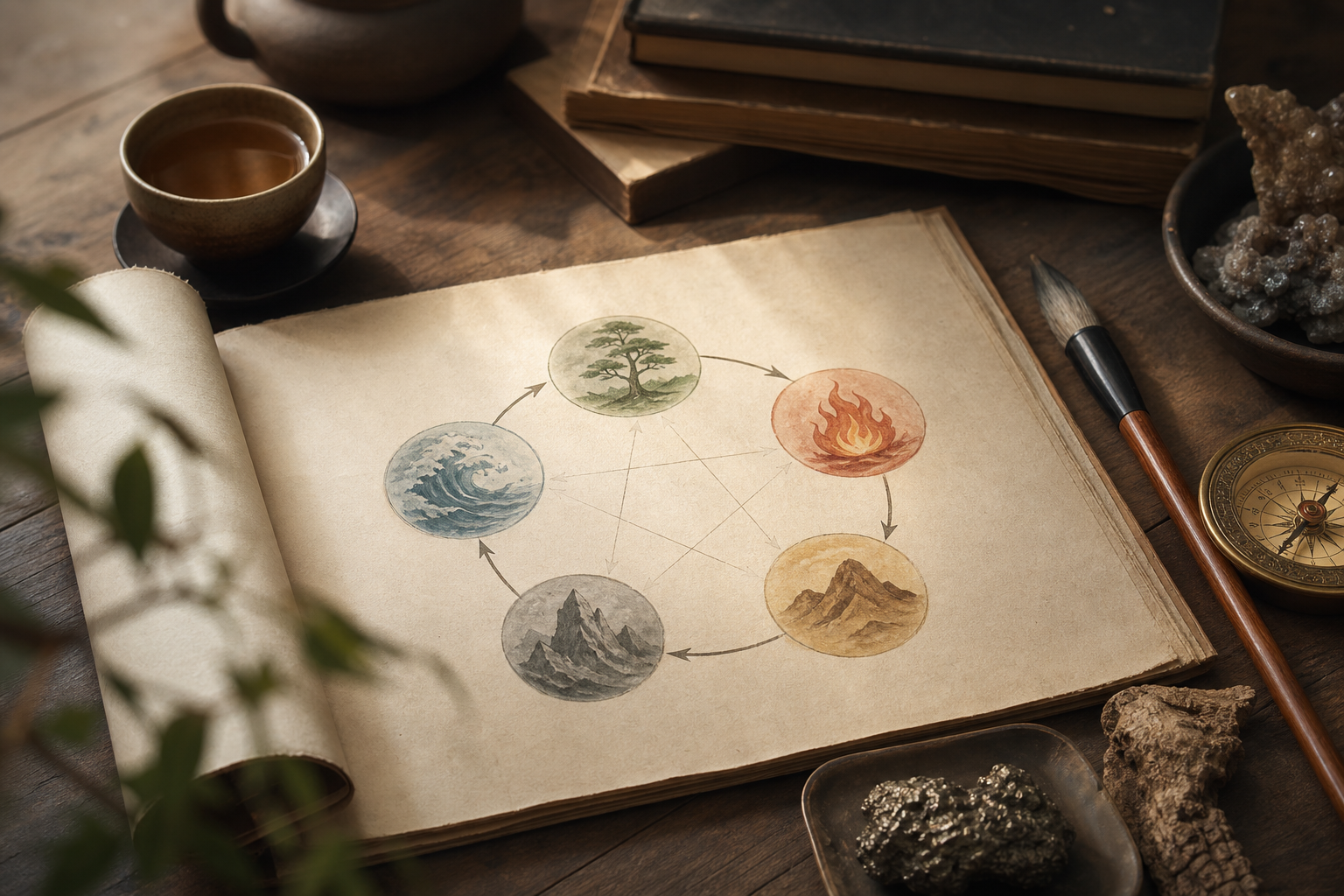
The five elements are one of the most important organizing ideas in Chinese metaphysics, but the word “elements” can mislead beginners. Wood, fire, earth, metal, and water are not meant as a simple list of physical substances. They are better understood as five kinds of movement or process. Each one names a style of energy, a way change happens, and a pattern of relationship. Once that becomes clear, the framework starts to feel much less abstract.
Wood suggests growth, extension, and reaching outward. Fire suggests heat, visibility, and upward expression. Earth suggests support, integration, and stability. Metal suggests definition, refinement, and boundary. Water suggests storage, depth, and adaptive flow. These are not just poetic words. They form a working language used across medicine, metaphysics, lifestyle, and environmental reading.
The Five Elements Describe Process
A useful beginner question is not “What object belongs to which element?” but “What kind of movement does this element represent?” That shift makes the system more alive. Wood is not only about trees. It is about growth and unfolding. Fire is not only about flames. It is about radiance and peak expression. Water is not only about oceans. It is about reserve, descent, and hidden potential. The categories become more useful the moment you read them as process rather than objects.
This process-based view explains why the framework can travel across so many fields. It can describe seasons, emotions, work styles, design choices, relationship patterns, and timing cycles. The categories remain stable because the underlying movements remain recognizable in many forms.
Generating and Controlling Relationships
Beginners usually hear early on that the elements “generate” and “control” one another. This is one of the most important parts of the system. The generating cycle shows support and sequence: wood feeds fire, fire creates earth, earth bears metal, metal carries water, and water nourishes wood. The controlling cycle introduces regulation: wood parts earth, earth absorbs water, water extinguishes fire, fire melts metal, and metal cuts wood.
These relationships matter because the system is not only descriptive. It is relational. An element is understood partly through what it feeds, what it restrains, what feeds it, and what restrains it. This helps explain why a chart, room, or timing pattern can feel balanced or strained. It is not enough to know which qualities are present. You must ask how they are relating.
How the Five Elements Help Beginners Read Pattern
The five elements help beginners read complexity without collapsing into chaos. Instead of seeing a life situation as one undifferentiated problem, you can begin asking more precise questions. Is there too much pressure and not enough support? Too much movement and not enough structure? Too much heat and not enough cooling depth? The framework offers pattern language for those differences.
It also becomes easier to understand why Chinese metaphysics often feels more dynamic than simple labeling systems. A person is not “a water person” in any final sense. A home is not solved by a single elemental tag. What matters is interaction, proportion, season, and context. That keeps the system flexible and prevents shallow interpretation.
Where Beginners Get Confused
The most common beginner mistake is memorizing correspondences without understanding function. Lists can be helpful, but if you memorize colors, organs, directions, or seasons without understanding the underlying movements, the framework stays brittle. Another mistake is using the elements too literally. The system is symbolic. A “metal” quality may appear as precision, boundary, or discernment, not as a piece of metal sitting on a desk.
That is why foundational study matters. The five elements make much more sense once you already understand relational thinking through Yin and Yang in Plain English and once you connect them to living ideas like What Does Qi Mean in Chinese Thought?.
FAQ
Are the five elements meant literally?
No. They are symbolic categories of process and relationship, not just physical objects.
Why are there only five?
The system uses five recurring modes of movement to describe many kinds of change. Its power comes from relationship, not from endless categories.
Do I need to memorize every correspondence now?
No. Start with movement and relationship first. Lists become more useful after you understand what each element is trying to describe.
What should I read next?
Read What Does Qi Mean in Chinese Thought?.
Where to Go Next
Continue with What Does Qi Mean in Chinese Thought?, Why Timing Matters in Chinese Metaphysics, and How Major Chinese Metaphysics Systems Fit Together.