Every element in BaZi moves through five stages: birth, growth, maturity, decline, and storage. The five stages describe how an element's energy behaves in different phases, and they appear throughout the system, from the seasonal strength of a chart to the way a day master responds to each pillar. For beginners, the stages are one of the most useful ideas in the whole framework, because they turn static lists of elements into a moving picture. This article explains the five stages and how to read them in a chart, building on the basics in Five Elements Balance in a Birth Chart.
The Five Stages at a Glance
The five stages are usually named after a life cycle: birth, growth, maturity, decline, and storage. Each element passes through all five as it moves through the year and through a chart. Wood, for example, is born in winter, grows through spring, matures in early summer, declines through late summer, and stores in autumn before the cycle repeats. The same logic applies to Fire, Earth, Metal, and Water, and together the five stages explain why the same element can feel strong in one season and weak in another.
This is why seasonal strength matters so much in BaZi. A day master element that is in its growth or maturity stage in the month pillar is considered stronger than one that is in decline or storage, because the season is supporting it. The practical result is that identical elements can behave differently depending on timing, a point explained in detail in Seasonal Strength in the Four Pillars.
How the Stages Apply to a Chart
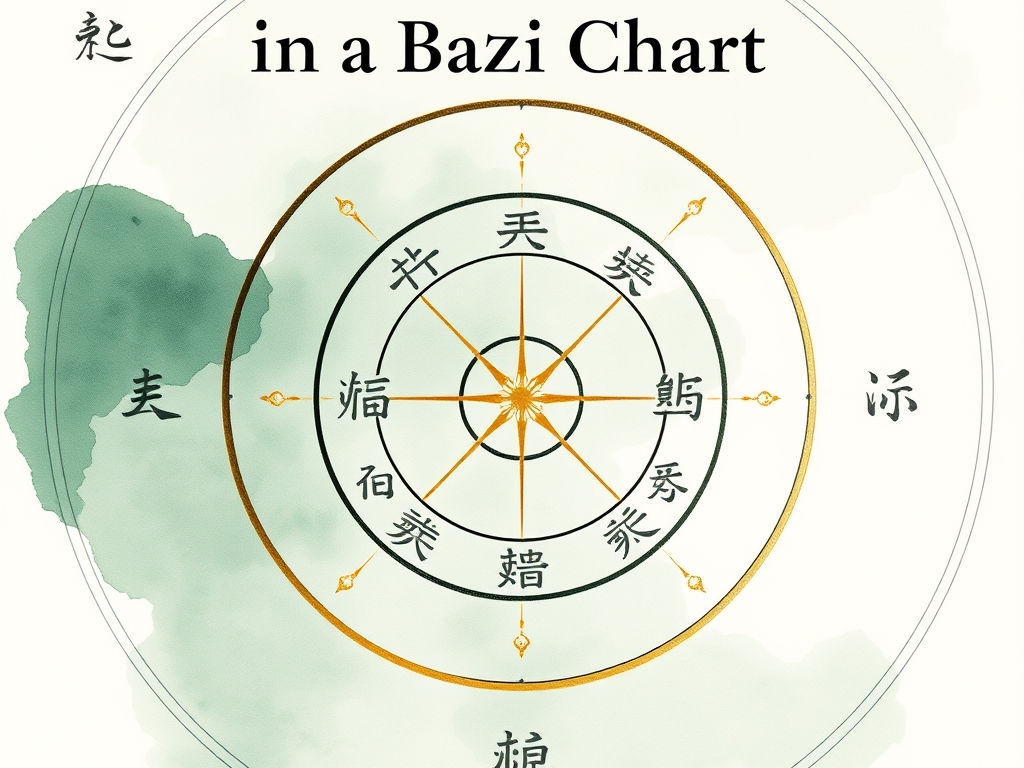
In a chart, the five stages are read through the relationship between an element and the season of each pillar. The year pillar, month pillar, hour pillar, and luck cycles all carry their own season, so the same day master element faces different stages in different periods of life. A chart with many supportive stages is not "good" in a moral sense; it simply describes an environment where the element can express itself easily.
The stages also appear in the ten gods, because each god is defined by how another element relates to the day master. An element that produces the day master is a Resource, an element the day master produces is an Output, and so on. Understanding the stages first makes the ten gods much easier to learn, because you are no longer memorizing names but reading relationships. A clear introduction to that layer is The Ten Gods in BaZi Explained Simply.
A Checklist for Reading Stages in Practice
Use this checklist when you want to see the five stages at work in a chart:
- Identify the day master element of the chart.
- Find the season of the month pillar and decide which stage the day master is in.
- Repeat the same step for the year and hour pillars, noting whether they support or pressure the day master.
- Compare the result with the person's own sense of energy across the year.
- Check whether the stage changes across luck cycles, since each cycle brings a new season of its own.
- Describe the pattern in plain language, such as "strong in spring, quieter in autumn," before interpreting anything.
The last step is the most important, because a stage is a description of emphasis, not a prediction of events. Reading the stages this way keeps the framework tied to observation, which is the approach recommended throughout this site. For the underlying element theory, see The Five Elements Explained for Beginners and The Cycle of Creation and Control.
Common Misconceptions About the Stages
The first misconception is that a stage in decline is bad news. Decline is a normal part of any cycle, and in the traditional view it is the phase where energy is harvested or stored rather than lost. A period of storage can be the most productive phase for preparation, study, and rest. The second misconception is that the stages are fixed for life. The month pillar sets the baseline, but luck cycles and the year pillar shift which stage is active at any given time.
The third misconception is that you must memorize all five stages for every element before you can use the system. In practice, beginners can start with one element and one season, such as Wood in spring, and gradually build the map. The chart is a study tool, and the stages are a way to organize its information, not a test of memory. For more on this attitude, read Common Misconceptions About BaZi.
Stages and Life Planning
The five stages become genuinely useful when you use them as a planning language. If a chart shows a day master in its growth stage for the current luck cycle, the emphasis is on building and expanding; if it shows storage, the emphasis is on consolidating and preparing. Neither stage is better, and both can be used deliberately: a growth period suits starting visible projects, while a storage period suits training, saving, and research.
This is where BaZi connects to ordinary decision-making, because the stages give you a vocabulary for why some years feel like launching and others feel like waiting. The connection between timing and effort is explored in The Relationship Between Timing and Effort and When to Start, When to Refine, and When to Pause.
A helpful exercise for beginners is to pick one element, such as Wood, and trace its five stages through a single year. Mark when the element is being born, when it is growing, when it matures, when it declines, and when it stores, then compare those points with your own projects and energy. The comparison turns the stages from an abstract cycle into a yearly rhythm you can actually use, and it prepares you for reading the same stages in a chart.
FAQ
Do I need to know all five stages to read a chart?
No. You can start with the stage of the day master in the current season and expand from there.
Is a decline stage always negative?
No. Decline and storage are normal phases that suit consolidation, preparation, and rest.
Do the stages change over time?
Yes. Luck cycles and annual pillars shift which stage is active, so the same element behaves differently in different periods.
Are the stages the same as the ten gods?
They are related but different: the stages describe an element's phase, while the ten gods describe how elements relate to the day master.