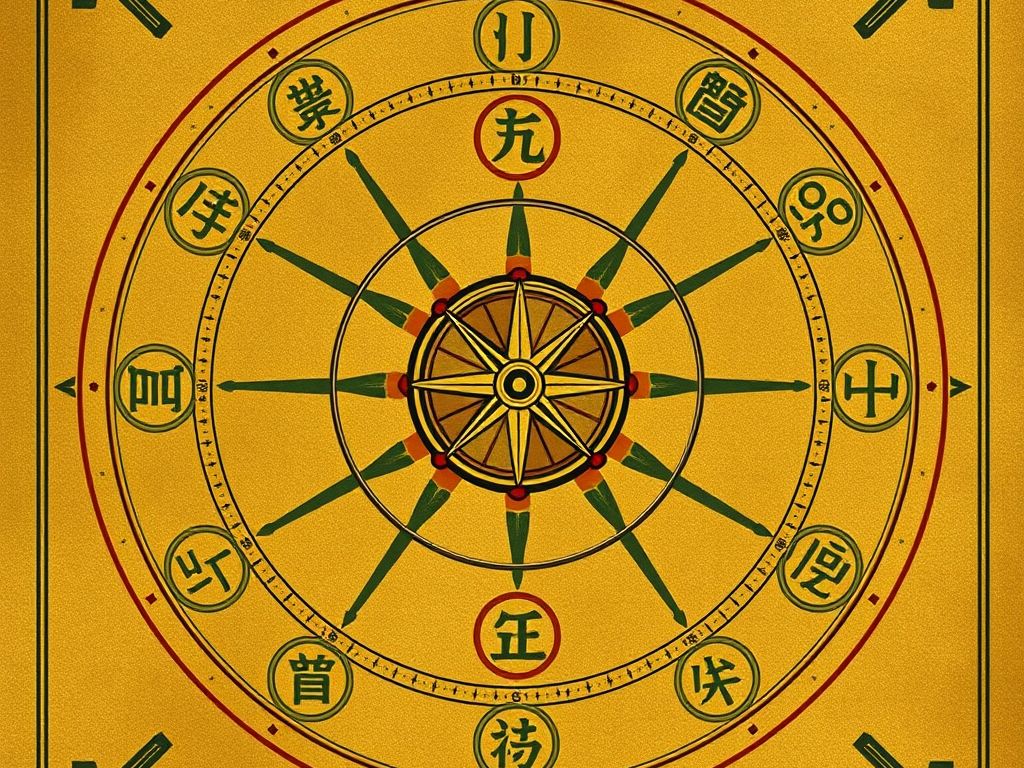
Qimen Dunjia uses time and direction to place a decision inside a specific symbolic setting. The chart is calculated for a moment, and its outer palaces correspond to eight directions. Together, these dimensions help a reader compare when and how an action might be approached. They do not mean that a favorable-looking compass point guarantees success or that you should travel without considering purpose, distance, safety, and ordinary constraints.
Why the Chart Time Matters
A Qimen chart is not timeless advice. Its arrangement belongs to a date and time selected according to the reading method. The moment may be when a question becomes clear, when a consultation occurs, or when an action is planned. Different schools may make different choices, but they share the principle that the chart needs a defined temporal reference.
Time matters because decisions unfold in windows. The best way to open a conversation at 9 a.m. may differ from the best way to respond after new information arrives at 4 p.m. In practical terms, timing includes availability, deadlines, readiness, sequence, and the pace of other people. Qimen expresses timing symbolically, while calendars and facts describe it directly.
A beginner should record the time zone, location convention if relevant, and reason for choosing the chart time. Do not quietly change the time after seeing an interpretation you dislike. Consistent records make it possible to learn from results rather than selecting whichever chart supports a preferred answer.
Direction Inside the Nine Palaces
The Qimen grid has eight outer palaces associated with north, northeast, east, southeast, south, southwest, west, and northwest. The center palace has no outward compass direction. Symbols placed in the outer palaces can therefore be discussed both in terms of their chart relationships and directional positions.
A direction may function literally, symbolically, or both. In a travel question, it may relate to a destination from a defined starting point. In an office question, it might describe where a meeting room or person is located. In a strategy question, a palace may represent an option or party even when nobody moves in physical space.
This distinction prevents a common mistake: assuming every directional interpretation is an instruction to face, walk, drive, or fly. Qimen can compare positions without prescribing movement. The reader must explain how direction connects to the actual question.
What "Favorable" Direction Really Means
In responsible practice, favorable is conditional. A direction may look more supportive for a particular purpose at a particular time relative to the alternatives considered. It is not permanently lucky, universally beneficial, or equally suitable for every person and activity.
Suppose one direction emphasizes visibility and quick contact. That may be useful for attending a public event, but less suitable for work requiring privacy. Another direction may support careful preparation while offering little speed. Neither is favorable in the abstract. The objective determines which quality is helpful.
Feasibility also qualifies favorability. A destination that is closed, inaccessible, unaffordable, unsafe, or unrelated to the goal does not become sensible because of a chart. A symbolic advantage cannot erase a hurricane warning, a dangerous route, visa requirements, mobility needs, or an exhausted driver. Personal safety and law are firm boundaries.
Scale, Starting Point, and Context
Directional language is incomplete without a starting point. North from your home, north from your office, and north from a destination city may indicate different places. Define the origin before evaluating a route. Also define the scale: crossing a room, traveling across town, and changing countries impose radically different costs and risks.
Context includes the action itself. Going east to buy coffee is not strategically equivalent to opening a branch office east of headquarters. A small, reversible experiment can tolerate more uncertainty than a large commitment. The more consequential the action, the more evidence, planning, professional input, and contingency preparation it deserves.
Online activity requires even more transparency. A remote interview may involve the applicant's room, the employer's office, a server location, and participants in several time zones. There is no need to pretend that one rigid directional rule resolves every digital situation. Some readers emphasize the user's physical orientation; others treat the chart palaces symbolically and focus on timing. State the convention and avoid certainty.
Example: Planning a Client Visit
Marcus has two possible days to visit a client and two possible locations: the client's main office west of his workplace or a shared conference venue southeast. The client prefers the main office, but the shared venue has better presentation equipment. Marcus also knows the travel times, weather forecast, attendee schedules, and meeting goals.
A hypothetical Qimen comparison suggests that the earlier day supports direct access but has signs of haste. The later day appears slower yet more cooperative. The western palace may fit a formal decision, while the southeastern palace appears better for exploration and presentation. These are reflective observations, not guaranteed outcomes.
Marcus can turn them into planning choices. If the contract decision is urgent, he might use the earlier day at the main office, leave extra travel time, and send materials in advance to reduce haste. If the meeting is meant to develop ideas and no deadline is pressing, the later presentation venue may better fit the purpose. If severe weather makes either trip unsafe, he moves the meeting online regardless of the symbolic picture.
The final decision integrates purpose, chart interpretation, equipment, preferences, schedule, and safety. Direction has informed the comparison without becoming a command.
Using Time Without Chasing the Perfect Moment
Timing analysis can become unhelpful when a person waits endlessly for an ideal chart. Most real decisions have imperfect windows. A workable time with adequate preparation is often better than a theoretically excellent time that violates the deadline or depends on unavailable people.
Instead of asking for a flawless moment, compare realistic windows. What can be completed before each one? Who must participate? What happens if you delay? Which risks are controllable? Use symbolic timing to refine a plan, then commit when the evidence and constraints support action.
Avoid checking every few minutes. Repeated charts can amplify anxiety and encourage selective interpretation. Choose a defined window, make notes, and revisit only when the conditions materially change.
Safety and Ethical Boundaries
Never use directional advice to pressure another person, trespass, enter unsafe areas, violate travel restrictions, or ignore health limitations. Do not encourage a client to make expensive travel plans solely on symbolic grounds. If a route or timing choice has legal, medical, or financial implications, consult qualified professionals and use reliable current information.
Direction is also not a tool for locating a private individual without consent or making accusations about hidden conduct. Ethical Qimen practice keeps the question focused on the user's choices, preparation, and appropriate communication.
FAQ
Do I have to travel in a favorable direction?
No. A directional palace may represent an option, person, or strategic position without physical travel. If movement is considered, it must serve a real purpose and remain safe and feasible.
How long does a favorable time last?
That depends on the chart method and the decision window. Avoid assuming a universal duration. Define the period being analyzed and use a practitioner or source that explains its timing convention.
What if the best-looking direction is impossible?
Remove it from the available choices. Compare feasible alternatives, or use the symbolic qualities as prompts for improving the option you can actually take. Impossibility is real information.
Can I use Qimen direction for online meetings?
Some practitioners adapt directional methods to online settings, while others emphasize timing or symbolic palace relationships. There is no need to claim one rigid rule. State the method, keep expectations modest, and prioritize preparation and communication.
Where to Go Next
For a focused guide to selecting among feasible compass options, read Choosing Favorable Directions with Qimen. To practice timing within ordinary choices, continue with Qimen Dunjia for Everyday Decision-Making. The Qimen Dunjia overview connects both topics to the larger system. Start with one decision window, one clear origin, and one purpose, then document the practical reasons behind your final choice.