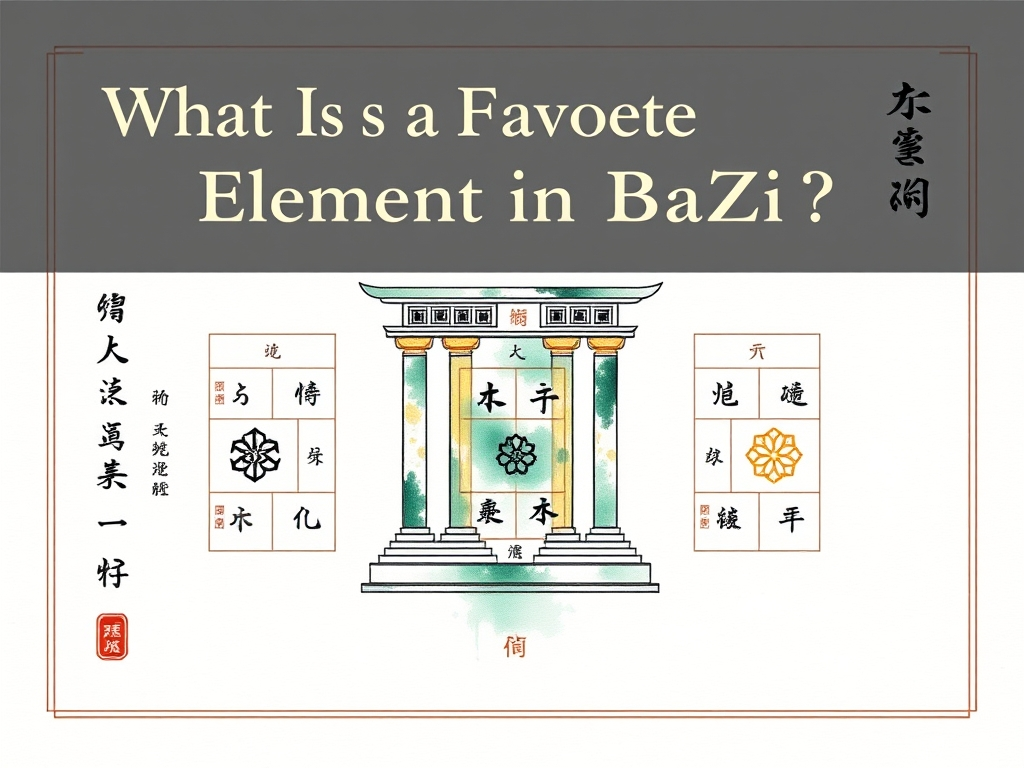
The phrase favorable element appears constantly in BaZi articles, and it is one of the most misunderstood ideas in the system. Beginners often assume that a favorable element is the one missing from the chart, or the one that brings luck, or the one associated with their zodiac sign. None of these shortcuts is reliable, and following them can produce advice that has little to do with the actual chart.
A favorable element is better understood as a working hypothesis. After studying the Day Master, the season, and the relationships between elements, a reader forms an idea of what would help the chart function more smoothly. That idea should be tested against experience, and it should change as the luck cycle changes. The element is favorable because of its function, not because of its name.
How Readers Identify It
The first step is always the Day Master. Its element and its strength in the season define what the chart needs. A strong Day Master may benefit from elements that give it outlets and structure, such as Output or Wealth. A weaker Day Master may benefit from elements that support and protect it, such as Resource. There is no single favorable element that works for everyone, because the same element can help one chart and burden another.
The second step is looking at the whole chart, including hidden stems and the current luck pillar. The element that appears missing at first glance may actually be supplied by a hidden stem or by the season. The element that appears abundant may be controlled or drained by another part of the structure. For the basics of how elements appear, read Five Elements Theory for Beginners.
Why It Is Not a Simple Fix
Once an element is labeled favorable, popular advice tends to turn it into a shopping list: wear this color, carry this object, move to this direction. A little of that can be pleasant symbolism, but it is not how the system works. The chart describes a structure of relationships, and a single element cannot repair a structure by itself.
What the favorable element actually offers is a way to think about timing and environment. If Water is helpful in your chart, you might notice that reflection, rest, and quiet environments support your decisions. If Metal is helpful, you might notice that clear boundaries and precise feedback clarify your work. The element becomes a lens for noticing what already helps, rather than a talisman to acquire.
How to Test a Favorable Element
Treat the favorable element as a hypothesis and run a simple experiment over two or three weeks:
- Write down the element your reading suggests is favorable.
- Name three practical expressions of that element in daily life, such as rest, structure, or movement.
- Add one of those expressions to your week deliberately.
- Keep a short note on whether energy, clarity, or mood changes.
- Compare the result with your chart notes after the experiment.
This turns abstract advice into evidence. If the experiment supports the hypothesis, the element earns its label for now. If it does not, the reading needs another look, and that is normal. The chart is a starting point for observation, not a conclusion. You can find your own chart and run the test with the BaZi calculator.
Common Mistakes to Avoid
The first mistake is assuming the missing element is automatically favorable. A missing element may be perfectly fine because the season or a hidden stem supplies it. The second mistake is treating the favorable element as permanent. The luck cycle changes which elements are active, so the helpful element today may not be the helpful element in ten years. The third mistake is confusing the favorable element with the zodiac element; the zodiac comes from the Year Branch, while the favorable element is a structural conclusion about the whole chart.
A fourth mistake is chasing fortune-telling language. No element guarantees wealth, health, or love. It describes a pattern of support, and the pattern only matters if it shows up in your experience. For a clear explanation of what a chart can and cannot do, see What a BaZi Reading Can and Cannot Tell You.
The Favorable Element and Timing
Timing changes the picture in two ways. First, seasons change elemental strength: a Wood element is stronger in spring, Fire in summer, Metal in autumn, Water in winter, and Earth at the turns of the seasons. A favorable element that is strong in its season will behave differently when it is out of season. Second, the ten-year luck cycle brings different elements into focus, so the support you need in your thirties may differ from what you need in your fifties.
This is why experienced readers describe the favorable element as a phase of the chart rather than a fixed property. The useful practice is to revisit the question whenever the luck pillar changes and whenever a significant life decision arrives. The element that helps you plan today is a working tool, not an identity. For more on how the luck cycle works, read Luck Pillars in BaZi and Why Timing Matters.
A Worked Example
Consider a Water Day Master born in winter. The season strongly supports Water, so the chart may become too cold and inward. A reader might suggest that Fire, the element that warms and expresses, is favorable. In practical terms, the person may notice that visibility, movement, and social warmth help them stay balanced, while excessive solitude drains them. The hypothesis is tested through activity: adding regular presentation, exercise, or bright social settings, and observing the effect.
Notice what the example does not say. It does not say the person should wear red and wait for luck. It names a functional need, expresses it in daily behavior, and tests it. That is the difference between a mature reading and a slogan. For more on reading your own chart with this mindset, browse the BaZi library and the BaZi section.
FAQ
Is the favorable element the same as my lucky element?
They are often used loosely, but a favorable element is a structural conclusion from your chart, not a lucky charm.
Does the favorable element ever change?
Yes. Seasons and the ten-year luck cycle change which elements are active, so the helpful element can change over time.
Should I buy objects or colors for my favorable element?
You may if you enjoy the symbolism, but the real value is in noticing which behaviors and environments support you.
Can I have more than one favorable element?
Yes. The chart usually has more than one supportive relationship, and different periods can highlight different ones.