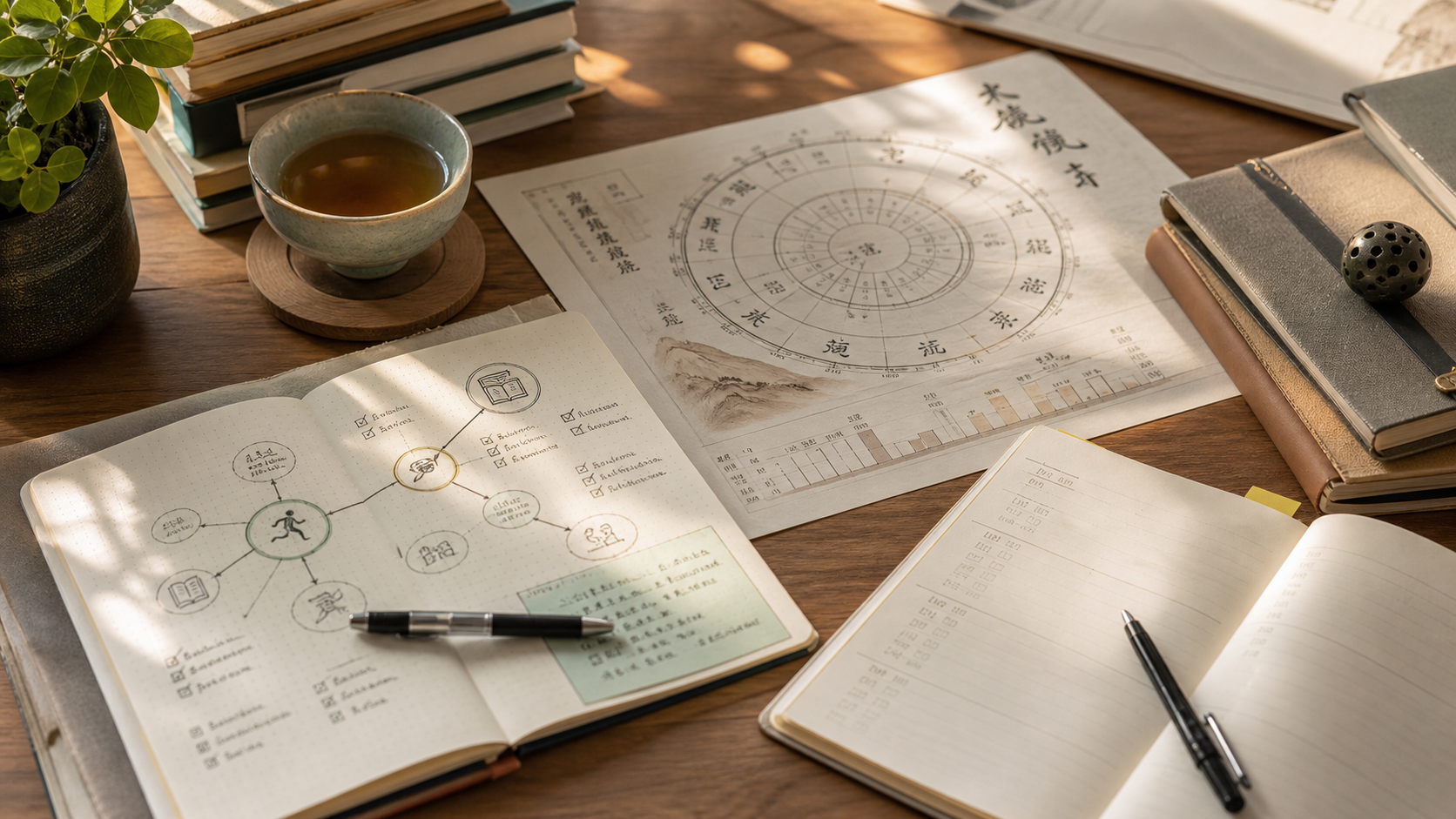
Most people have experienced it. You sit down ready to push hard, but the day refuses to become a clean execution day. Ideas are present, structure is needed, and decisions want shaping before action. On another day, the opposite happens: strategy is already clear and action flows quickly. Daily guidance gives language to this difference. Not every day is an engine day. Some are architecture days.
The mistake many people make is treating this shift as failure. They assume that if they are not driving visible output, they are wasting time. In reality, planning and pushing are different kinds of labor. Each has its own timing quality. Learning to tell them apart is one of the most valuable practical uses of Chinese rhythm-based thinking.
Planning Is Not Passive
Planning days are often misunderstood because they do not always look impressive from the outside. Yet they are the days when direction becomes cleaner, priorities sort themselves, and wasteful action gets prevented. A well-used planning day can save a week of misapplied effort. This is why daily guidance does not rank planning below execution. It asks what kind of work fits the current pattern.
On a planning day, it may feel easier to outline, compare options, review commitments, clean up scattered tasks, or decide what not to do. That is not laziness. It is alignment. When a person misreads such a day and tries to force heavy output, the result is often scattered work with low staying power.
What a Pushing Day Feels Like
A pushing day usually has a stronger line through it. Decisions feel less muddy. Energy moves outward. The mind does not want infinite revision; it wants motion. These are often the days to ship work, close loops, initiate calls, finish stored tasks, or move visible pieces forward.
Even so, a pushing day is not always aggressive. Sometimes it simply means the path is clear enough to act. The practical question is not “Is today lucky?” It is “Does today want movement or shaping?” That question keeps timing readable and sane.
How to Notice the Difference Earlier
The earlier you notice the day’s quality, the less energy you waste fighting it. Look at your first hour. Are you naturally sorting and framing? Or are you already reaching for execution? Look at your resistance pattern too. If action feels blocked because the structure is still unclear, you may be on a planning day. If structure feels obvious and delay begins to look like avoidance, the day may be asking for movement.
This is where journaling or a short daily note can help. Over time, you begin to see recurring timing patterns rather than isolated moods. That kind of self-observation pairs well with What Is Daily Guidance in Chinese Metaphysics?.
Use the Day Instead of Grading It
A planning day is not lower value than a pushing day, and a pushing day is not more virtuous than a planning day. They simply serve different purposes. Trouble begins when people use one standard for every type of day. If your system only rewards visible action, you will underinvest in design, sequence, and reflection. If your system only rewards reflection, you may never cross the threshold into committed action.
Daily guidance is useful because it restores fit. It helps a person ask what kind of labor is most honest for today. That question alone can reduce frustration and improve output quality.
FAQ
How do I know if I am just procrastinating?
If planning is producing clarity, structure, and better sequencing, it is work. If it is only avoiding commitment, it may be procrastination disguised as strategy.
Should I cancel tasks on a planning day?
Not necessarily. You may simply shift emphasis, handling lighter execution while giving more room to review, map, and sequence the bigger work.
Can teams use this idea too?
Yes. Teams often work better when some meetings are clearly for shaping and others are clearly for execution, rather than blending both badly.
What should I read after this?
Read What Kind of Work Fits Rising, Peak, and Fading Energy for a broader timing map.
Where to Go Next
Continue with What Kind of Work Fits Rising, Peak, and Fading Energy and When to Start, When to Refine, and When to Pause. Or browse all Daily Guidance articles from the archive.