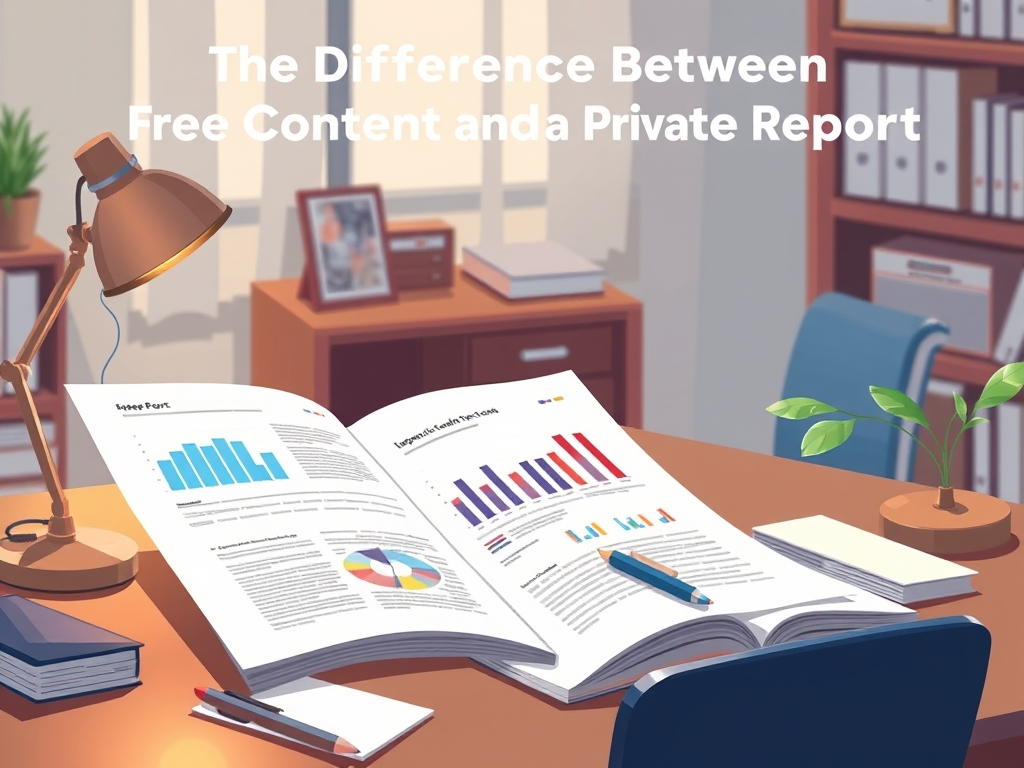
Free content about BaZi, Qimen, and feng shui is everywhere, and much of it is genuinely useful. It explains concepts, introduces vocabulary, and helps you decide whether a deeper reading is worth your time. A private report is a different kind of object: it applies those concepts to one specific chart and one specific set of questions. Understanding the difference between the two saves both money and disappointment.
The distinction is not quality. A good free article can be excellent, and a bad private report can be worthless. The distinction is generality. Free content is written for many readers; a private report is written for one. The question is not which is better but which one answers the question you actually have.
What Free Content Can Do
Free content teaches the system. It explains what a Day Master is, how the ten-year luck cycle works, what a Qimen door means, and how the bagua map applies to a home. It also gives you a vocabulary for describing your own observations, which is valuable even if you never order a reading. Reading broadly before a private consultation is one of the best ways to prepare for it.
What free content cannot do is tell you what is true for your chart. A general article about the month pillar cannot say whether your month pillar is strong or weak, because that depends on your year, day, and hour as well. For the general knowledge base, browse the BaZi library and What a BaZi Reading Can and Cannot Tell You.
What a Private Report Adds
A private report applies the framework to your data. It identifies your Day Master, checks its seasonal strength, reads the Ten Gods in your chart, and connects the current luck cycle to your specific life areas. A Qimen brief does the same for a specific decision and moment. The report's value is synthesis: it turns a general system into a description of your situation that you can test against experience.
A serious report also names its limits. It distinguishes what the chart suggests from what you must decide, and it flags uncertain data such as an approximate birth time. For an example of what a thorough report contains, read What a BaZi Report Actually Contains.
How to Choose Between Them
The choice depends on the question. If you are learning the system or satisfying curiosity, free content is enough, and it will be more useful if you read it actively. If you are facing a specific decision, a repeated pattern, or a transition and want the framework applied to your own chart, a private reading is the appropriate tool. The two are not competing; most people use both.
A practical sequence is to read free content first, write down your questions, and then decide whether a report would answer them more precisely. For help forming those questions, read How to Ask Better Questions Before a Reading.
A Decision Checklist
Use this checklist before ordering a private report:
- Have I read enough free content to know what the system can and cannot do?
- Can I state my question in one or two concrete sentences?
- Do I have my birth data, including place and approximate time?
- Am I ready to receive a description of conditions, not a prediction?
- Would a general article actually answer this question?
If the last question is yes, save the money and read. If the answer is no and the other four are yes, a private report is a reasonable next step. For the practical side of ordering, read What to Ask Before You Purchase a BaZi Reading.
Common Misconceptions
The first misconception is that a private report reveals secrets hidden from free content. The concepts are the same; the report applies them to your data. The second misconception is that free content is a cheap substitute for a reading. For a specific decision it is not a substitute, and expecting it to be one causes frustration. The third misconception is that a private report is always more accurate than free content.
Accuracy depends on the reader, the data, and the honesty of the interpretation, not on the price. A report that flatters or predicts is not more accurate; it is less serious. For how to judge quality, read How to Evaluate the Quality of a Reading.
How to Use Both Together
The best use of the two is a loop. Read free content to build vocabulary, order a report for a specific question, then return to free content to understand the report's language. The report becomes a case study you can study, and the free content becomes the grammar for that case study. The loop deepens both.
This is also how people decide whether future reports are worth ordering: after the first report, compare its descriptions with your experience over the following months. For the follow-up practice, read When Is a Personal Reading Worth It?.
A Worked Example
A person reads several free articles about the luck cycle and realizes they are entering a transition year. They order a report that applies the transition to their chart, and the report describes a period of consolidation rather than expansion. Over the following year, they find the description accurate: the year rewarded study and steady work, not launches. The free articles made the report comprehensible, and the report made the articles personal.
The example shows the division of labor: the articles explained, the report applied. For more on the report side of the library, browse the reports library or read When Is a Personal Reading Worth It?.
FAQ
Is a private report always worth the cost?
It is worth it when you have a concrete question and the reader applies the system honestly to your data.
Can I understand a report without reading free content first?
You can, but the report will make more sense and be more useful if you have the basic vocabulary.
Do free articles and reports contradict each other?
They should not, because both use the same framework; a report simply applies it to one chart.
What if I only want general knowledge?
Then free content is the right tool, and a private report would be unnecessary.